
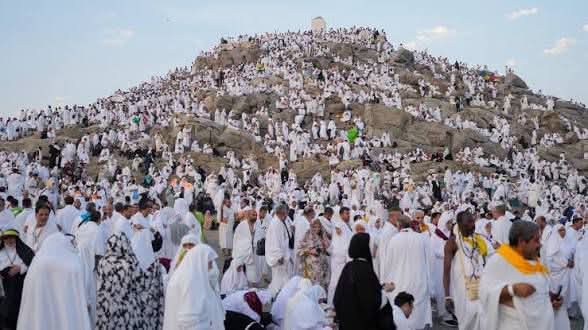

After the physical and emotional trials of Mina, arriving at Arafat felt almost like entering another world entirely.
The difference was immediately noticeable.
There was less congestion, fewer struggles over space, shorter queues at the toilets and a calmer atmosphere overall. Though modern inconveniences still remained — particularly the long queues to charge mobile phones — the experience at Arafat was far more relaxed and organized than what we had endured in Mina.
Yet, spiritually, this was the most important phase of the Hajj.
For pilgrims, the Day of Arafat represents the climax of the pilgrimage. It is the day millions gather on the plain of Arafat in total submission to Allah, praying for forgiveness, mercy and acceptance. Islamic tradition holds that it was here that humanity’s redemption story unfolded and where the Holy Prophet Muhammad (SAW) delivered his famous farewell sermon, laying down timeless principles of justice, equality and human dignity.
The journey from Mina to Arafat began unusually early — around midnight.

The decision was deliberate: officials wanted to avoid the massive traffic congestion that traditionally accompanies the movement of millions of pilgrims between the holy sites.
As is customary, women pilgrims were transported first. Other pilgrims followed, while officials and members of the delegation waited behind. But one thing quickly became obvious: this year’s operation was moving far more efficiently than anticipated.
Within barely two hours, all the pilgrims had already been evacuated successfully.
At around 2:00 a.m., we — the officials led by the Amirul Hajj, Ahmad Usman El-Marzuq — were informed that it was finally our turn to proceed to Arafat. Yet many of us hesitated.
In an ideal Hajj arrangement, pilgrims are expected to spend the night in Mina before departing after the Subhi prayer. Wanting to preserve the spiritual essence of that tradition, we chose to remain in Mina a little longer until after the dawn prayer before embarking on the journey.
What awaited us in Arafat was astonishing.
My mind immediately drifted back twenty years to the 2006/2007 Hajj season.
Back then, reaching Arafat was itself an ordeal. Vehicles could barely get close because of congestion. Pilgrims were dropped several metres — sometimes kilometers — away from their destinations and forced to trek through endless crowds under the harsh desert conditions.
This time was completely different.
To my utter surprise, our vehicle drove smoothly right into the Arafat camp area and stopped directly in front of our designated hema. There was no chaos. No confusion. No endless sea of stranded buses. The roads were clear, orderly and properly coordinated. Vehicles were neatly parked with enough room left for movement and emergency access.
Part of this remarkable transformation is connected to the massive modernization introduced by the Saudi authorities for the 1447 AH Hajj season.
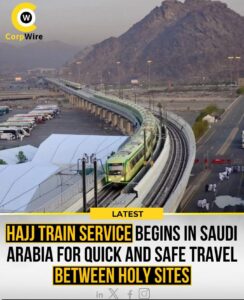
This year, Saudi Arabia launched its expanded holy sites train service designed specifically to move millions of pilgrims quickly and safely between Mina, Muzdalifah and Arafat. The modern rail system now transports thousands of pilgrims within short periods, significantly reducing traffic congestion and pressure on the roads.
Railway officials closely monitor the movement of the trains and coordinate transportation schedules with Hajj authorities to ensure smoother movement between the sacred sites. Combined with improved road management, digital coordination systems and tighter crowd-control arrangements, the result has been a much calmer and more organized pilgrimage experience for many worshippers.
For pilgrims like us who witnessed the conditions two decades ago, the improvements are striking.
It was difficult not to marvel at the transformation.
Even more surprising was the accommodation itself.
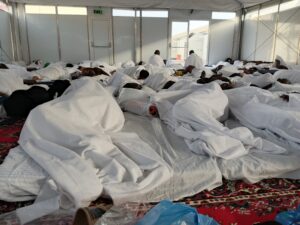
Like in Mina, every pilgrim had an allocated hema and bed space. The tents were spacious and fully air-conditioned, providing pilgrims with much-needed comfort under the desert heat.
Again, my memories went back to 2006/2007.
At that time, there were no such organized arrangements for us. We were simply dropped on the open plain of Arafat with minimal shelter and basic facilities. Pilgrims struggled to find shade while enduring the scorching weather.
Perhaps the difference lies partly in the type of arrangement. During that earlier pilgrimage, I had travelled through an international flight under a private travel agency rather than through a State Pilgrims Welfare Board system with coordinated government-backed logistics.
But beyond that, it is undeniable that the organization of Hajj itself has evolved tremendously over the decades.
Technology, planning and crowd management have transformed what was once an overwhelmingly chaotic movement into a far more structured exercise. The Saudi authorities, together with Hajj missions from various countries, continue to introduce improvements aimed at making the sacred rites safer and more manageable for millions of worshippers.
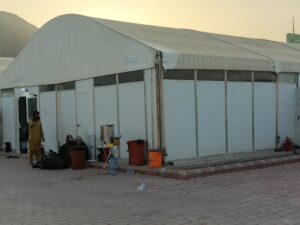
Inside the hemas, however, some familiar realities remained.
Just like in Mina, there were no separate mosque spaces immediately available for our group prayers. Before each congregational prayer, mattresses had to be shifted aside to create enough room for worshippers to stand shoulder to shoulder.
The Zuhur and Asr prayers were combined and shortened in accordance with the rules guiding travelers during Hajj. Rows quickly formed inside the tent as pilgrims stood quietly in devotion on what many Muslims regard as the most spiritually significant day of their lives.
After the prayers, designated preachers gathered the pilgrims and carefully guided them on the next phase of the Hajj rites. Instructions were calmly explained so that nobody would be confused about the sequence of events that would follow after Arafat.
But before the next rituals commenced, pilgrims were served a well-balanced lunch complete with dessert — another reminder of how much welfare arrangements have improved over the years. In earlier times, pilgrims often struggled to secure even basic meals during the peak Hajj days. This time, organized feeding arrangements ensured that pilgrims could focus more on worship than survival.
Still, even with all the comfort and organization, Arafat remains deeply humbling.
Here, titles lose meaning. Wealth becomes irrelevant. Pilgrims sit together in simple white garments, hands raised toward the sky, pleading to their Creator with tears, regrets, hopes and prayers.
And perhaps that is the greatest beauty of Arafat.
It is not the air-conditioned tents, the organized train services or the orderly parking spaces that leave the deepest impression. It is the overwhelming realization that on this plain, humanity stands equal before Allah — stripped of status, emptied of pride and united only by faith and the hope for mercy.