

By Ibrahim Kaula Mohammed
There is an old saying that a reputation arrives before its owner. In March 2026, Katsina State did not need an introduction—its reputation had already spoken.
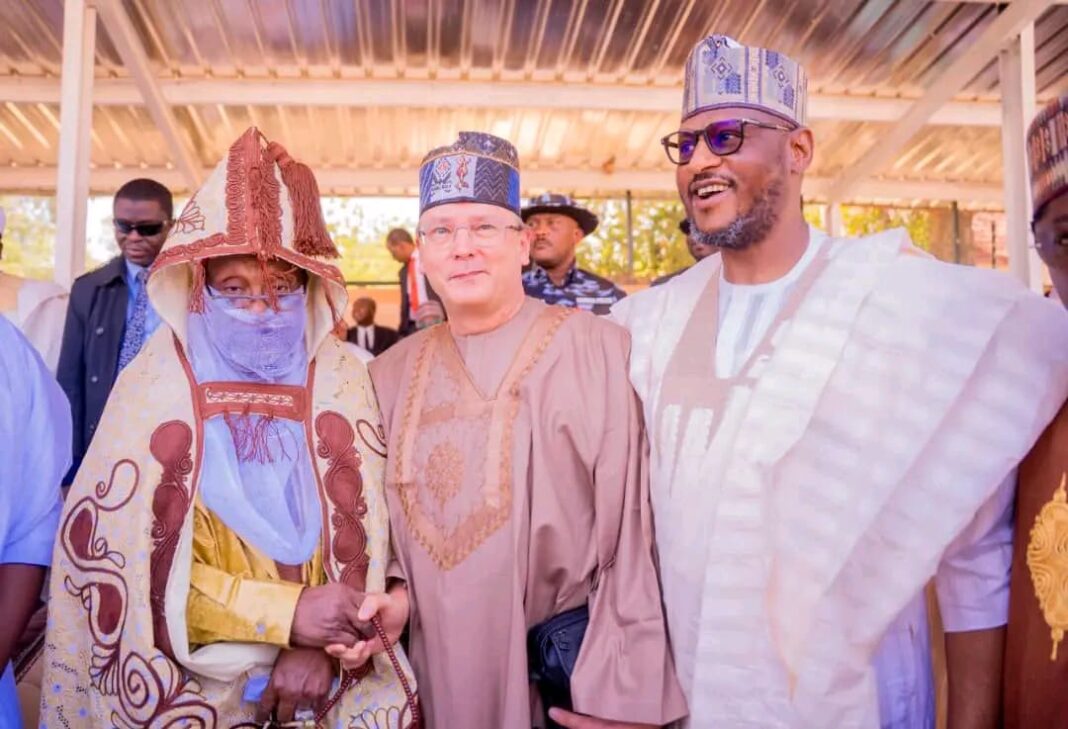
As part of activities marking the 2026 Eid-el-Fitr celebrations, no fewer than seventeen foreign diplomats arrived at the Umaru Musa Yar’adua International Airport. For many, it was not their first encounter with Katsina; for others, it was a return to witness, firsthand, the state’s evolving story. The delegation included representatives from Belgium, Egypt, the Netherlands, Spain, Poland, Switzerland, Slovakia, Argentina, Congo, and Italy.
Also in attendance were senior international figures, including representatives of the United Nations system such as Mohamed Malick Fall, alongside global investors like Kay Kimmelman, CEO of NewGlobe Inc. These are individuals who travel not on sentiment, but on informed judgment—guided by reputation, credibility, and confidence.
The numbers tell a compelling story. In 2025, ten diplomats attended the Eid festivities in Katsina. In 2026, that number rose to seventeen. This is not coincidence—it is a signal.
Governor Dikko Umaru Radda has cultivated a leadership style defined by personal engagement. Rather than delegate the استقبال of his distinguished guests, he personally received them at the airport, accompanied by his deputy, Hon. Faruk Lawal Jobe.
He led the delegation to the palace of the Emir of Katsina, Abdulmumini Kabir Usman—a gesture that resonates strongly in diplomatic circles. It reflects a leadership that values relationships and understands the symbolic power of presence.
At the heart of the celebrations was the Katsina Durbar—more than a spectacle, it is a living expression of heritage. Horsemen from 28 districts rode in elaborate regalia, embodying centuries of tradition. The rhythms of the kalangu and algaita drums filled the air at Kofar Soro, as royal processions unfolded with elegance and precision.
This is a tradition that has endured empires, colonialism, and modernity—remaining a defining feature of Katsina’s identity.
Addressing the visiting envoys during the Hawan Sarki, Governor Radda noted that their presence reflected growing global confidence in the state. The Emir reinforced this message, emphasizing that peace and development are rooted in cooperation, mutual respect, and shared responsibility.
Beyond the cultural displays, the delegation was taken to key development sites that underscore the administration’s priorities.
At the Katsina Agricultural Mechanisation Centre, the envoys observed investments in modern farming—ranging from tractor deployment to mechanised support systems aimed at improving productivity across the state.
They also visited a state-of-the-art dialysis centre, where ongoing efforts to strengthen healthcare delivery were evident. The facility is part of a broader strategy to position Katsina as a regional hub for specialised medical services.
The diplomats’ reactions were telling. Their commendations were not for staged presentations, but for functioning systems with visible impact on citizens’ lives.
One of the most striking stops was at a Smart Secondary School in Dutsin-ma. Though not yet fully commissioned, the facility left a strong impression on the visiting delegation.
Designed to cater to children from rural and disadvantaged backgrounds, the schools are equipped with 24-hour electricity, ICT-enabled classrooms, hostels, and internet access—all provided free of charge.
This is a long-term investment—one whose true impact will be measured not in months, but in generations.
From modern classrooms, the delegation moved into deep history at the ancient Kusugu Well in Daura, believed to be over 2,000 years old.
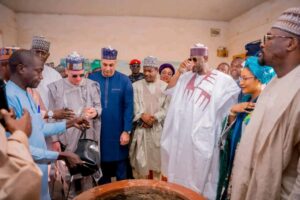
The visit underscored a broader philosophy: that heritage is not a relic, but an asset. States that understand their past are better positioned to navigate their future.
None of these activities—cultural, developmental, or diplomatic—would have been possible without a stable security environment.
The smooth movement of seventeen diplomats across multiple locations, without incident, speaks volumes. While challenges remain, the state’s multi-layered approach—including the establishment of community-based security structures—has begun to yield results.
Security, in this context, is not treated solely as a military issue, but as a collective responsibility involving communities and institutions.
Beyond impressions, the administration presented tangible outcomes:
- A 2026 budget driven by community needs assessments, with each of the 361 communities receiving over ₦10 million for priority projects.
- Annual distribution of 40,000 metric tonnes of fertiliser at subsidised rates.
- Deployment of over 400 tractors across all 34 local government areas.
- Recruitment of more than 7,000 teachers and significant investment in school infrastructure.
- Upgrading of over 250 primary healthcare centres.
- Clearance of over ₦45 billion in inherited pension liabilities.
For investors and international partners, such figures matter. They represent delivery, not just promises.
The diplomatic engagement extended beyond observation. Discussions led to commitments in areas such as education, agriculture, food security, SME development, women’s empowerment, and technology.
Coordinated by the Katsina State Development Management Board, the sessions were structured to produce actionable outcomes—not ceremonial exchanges.
The increase in diplomatic presence—from ten to seventeen within a year—captures Katsina’s rising profile under Governor Radda.
The state is not without challenges. Security concerns persist, and development remains a work in progress. Yet, the direction is clear.
The 2026 Eid-el-Fitr festivities demonstrated that Katsina is open—open for culture, investment, and partnership. They also showed that leadership, when anchored in visibility, delivery, and cultural pride, can reshape perception.
Governor Radda appears to understand a simple but powerful truth: culture is currency, infrastructure builds credibility, and security is the foundation upon which everything else rests.
Katsina extended that message to the world. The world responded—not just by listening, but by showing up in greater numbers.
And that, perhaps, says it all.
Ibrahim Kaula Mohammed is the Chief Press Secretary to the Governor of Katsina State.