

By Ahmed Abdulkadir
There is something powerful about a journey that refuses to break under the weight of disappointment.
In Kano, as the state government welcomes back over a hundred foreign-trained scholars under its expanding human capital development drive, the story is often told in numbers—figures of beneficiaries, countries of study, and sectors to be transformed. But behind those statistics are human stories—stories of waiting, endurance, faith, and, ultimately, triumph.
One of such stories is that of Haruna Adamu Dawakintofa.
His journey does not begin in India, where he earned a postgraduate degree, nor does it begin with his recent appointment as a lecturer. It begins earlier—with promise, and then with silence.
In 2018, Haruna graduated from Northwest University, Kano with a First Class degree, emerging as the overall best student of his set. It was the kind of achievement that should open doors. And for a moment, it seemed it would. Promises of employment followed—assurances that his brilliance would not go to waste.
But like many young Nigerians, he soon discovered that promise and reality are not always aligned.
The job never came.
Years passed.
At some point, he chose dignity over despair. He accepted a position as a primary school teacher under the State Universal Basic Education Board (SUBEB), Kano. For some, that might have felt like a step down. For Haruna, it became a step forward—an opportunity to remain productive, to serve, and to keep hope alive.
Still, he wanted more—not just for himself, but for what he believed he could become.
Then came the opportunity that would change the direction of his life: a foreign scholarship.
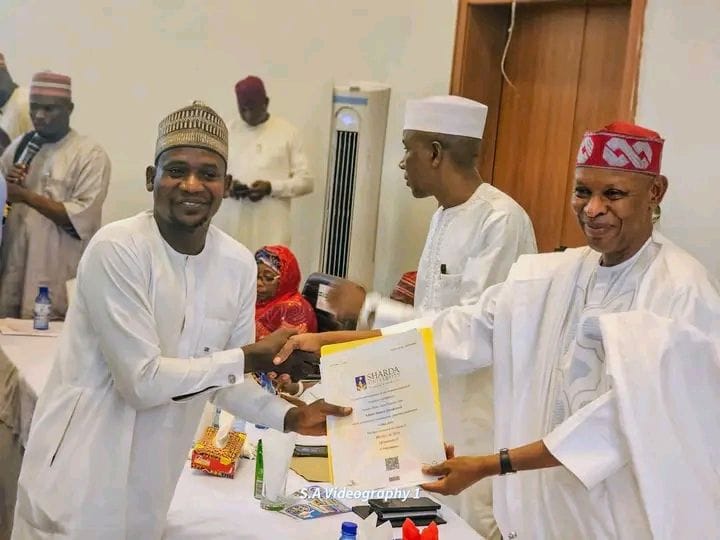
Far from home, in Sharda University, Greater Noida, India, Haruna immersed himself in study once again. The same discipline that earned him a First Class degree in Nigeria followed him abroad. After two years of rigorous academic work, he graduated with an MSc in Economics, First Division.
It was not just another certificate. It was proof—proof that his brilliance was not accidental, and that given the right platform, he could thrive anywhere in the world.
But perhaps the most defining part of his story is what happened next.
He came back.
At a time when many young Nigerians seek every possible path to remain abroad, Haruna returned home—back to Kano, back to the system that once overlooked him, but which he still believed in enough to serve.
And this time, the system responded.
Under the administration of Governor Abba Kabir Yusuf, which has placed education at the centre of its “Kano First” development agenda, returning scholars like Haruna are being deliberately reintegrated into key sectors. Their global exposure is no longer meant to be an individual achievement—it is now a collective asset.
Haruna applied for redeployment into higher education. It was not automatic. It required patience once again. But eventually, approval came.
Today, he stands on a new threshold—as a lecturer at the College of Arts and Remedial Studies (CARS), Kano, contributing to programmes that shape the academic foundation of countless young people, from remedial classes to degree pathways.
It is a quiet victory. Not loud, not dramatic—but deeply meaningful.
There is something symbolic about his placement. Though university regulations did not allow direct transfer into a university system, his presence in a college that prepares students for higher education places him at a critical junction—bridging aspiration and opportunity for others, just as he once stood in that uncertain space himself.
And still, he is not done.
Somewhere in his plans is another dream—a PhD opportunity in Turkey, currently in progress. It is a reminder that growth, for him, is not a destination but a continuous journey.
Yet beyond the certificates, beyond the appointments, what defines Haruna is something less visible but far more enduring: humility.
Those who know him speak of a young man who remains deeply respectful, grateful, and grounded—someone who still seeks guidance, who still values mentorship, who still says “Nagode Baba” with sincerity.
In many ways, his story captures the very essence of what Kano’s investment in education hopes to achieve. Not just graduates—but individuals shaped by resilience, purpose, and a strong sense of responsibility.
As the state celebrates the return of its scholars, it is easy to focus on policy, on programmes, on projections. But perhaps the real measure of success lies in stories like this—stories that remind us that behind every policy is a person, and behind every statistic is a life still being written.
Haruna Adamu Dawakintofa is one of those lives.
And in his journey, one finds not just the story of a scholar—but the quiet, persistent rise of hope.