

For many pilgrims, the spiritual beauty of Hajj is often imagined through the sight of the Ka’abah, the serenity of Madinah, or the emotional standing at Arafat. But for those who have truly experienced the pilgrimage, Mina is where the real test begins.
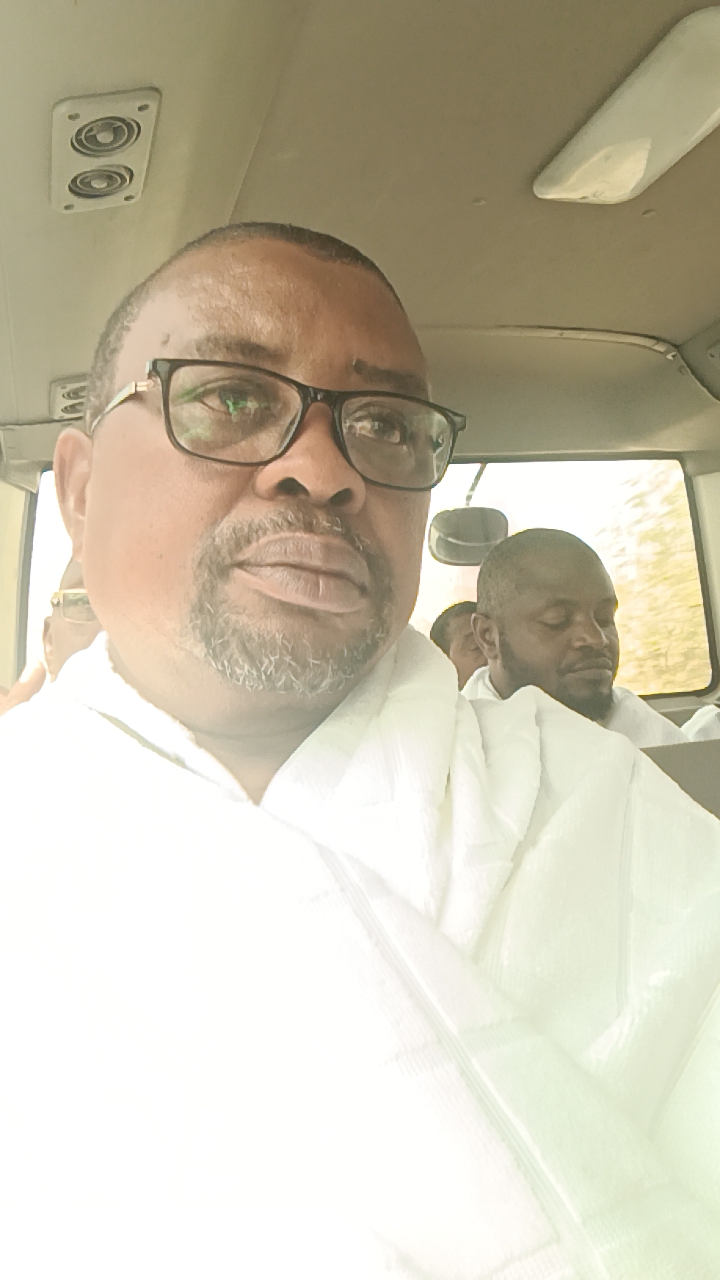
On the morning of our departure from Makkah to Mina, we set out around 9:50 a.m. in buses alongside thousands of other pilgrims moving toward the valley that would temporarily become home to millions from across the world.

Mina is unlike any other place during Hajj. It is a city of tents that comes alive only for a few days every year, accommodating humanity in one of the largest temporary gatherings on earth. It is here that pilgrims spend the days of Hajj in devotion, patience and sacrifice — values that define the pilgrimage itself.
Yet, as spiritually rewarding as Mina is, it is equally demanding.
Almost immediately after arrival, challenges emerged.
Accommodation spaces reserved for the Amirul Hajj, members of the Katsina State delegation, State Assembly members and officials of the Katsina State Pilgrims Welfare Board had already been taken over by some pilgrims. As a result, officials and delegation members had to be redistributed into other hemas — the designated tent sections in Mina — in cramped batches of four and five.
Further checks revealed that some pilgrims who had not originally been allocated bed spaces had occupied places reserved for officials and were even being protected by fellow Katsina pilgrims. In an act of sacrifice and responsibility, some management staff of the Pilgrims Welfare Board voluntarily surrendered their own sleeping spaces so that others could have somewhere to rest.
The overcrowding challenge had actually begun before arrival in Mina.
While departing from Makkah, about 50 pilgrims who were not from Katsina State attempted to board buses designated specifically for the Katsina contingent. The move was detected and stopped by vigilant officials and the Amirul Hajj, Ahmad Usman El-Marzuq.
Even after arrival, enforcement continued. The Amirul Hajj personally moved round the tents with officials and discovered about 30 individuals who had illegally sneaked into Katsina’s allocated hemas. They were subsequently flushed out to restore order and reduce congestion. During the inspection, he also supervised repairs of malfunctioning air-conditioners in some tents — a crucial intervention considering the intense desert heat in Mina.
But perhaps the greatest challenge facing pilgrims in Mina is not even accommodation. It is the struggle for basic necessities.
Something as simple as using the toilet can become a test of endurance. Long queues, sometimes stretching to as many as 50 people, become common. Elderly pilgrims, weakened by age and fatigue, often suffer the most. Some reportedly could not hold themselves any longer and ended up urinating in their ihram garments before their turn arrived — an experience that combines physical discomfort with emotional distress for pilgrims trying to preserve ritual purity.
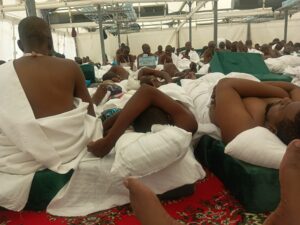
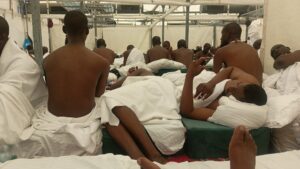
Unlike ordinary cities, Mina has no traditional neighborhood mosques close by for every group. Inside the tents, mattresses must often be shifted and rearranged before congregational prayers can be observed. In those moments, sleeping areas transform into prayer grounds, reminding pilgrims that Hajj is built around sacrifice, adjustment and collective endurance.
Yet amid these difficulties, significant improvements were also evident compared to earlier Hajj experiences.
During the 2006/2007 Hajj season, pilgrims in Mina were not provided mattresses. Every pilgrim had to arrive carrying personal mats and bedding materials. This year, however, the improvements were remarkable. Comfortable mattresses were provided for pilgrims, complete with pillows, and some could even be folded into cushion-like seats for easier sitting and resting inside the crowded tents.
Though conditions remain difficult due to the enormous number of pilgrims gathered in one place, the improvements reflected continuing efforts to make the Hajj experience more manageable.
Modern problems, however, have also emerged alongside modern conveniences.
Phone charging points are extremely limited. In an age where pilgrims rely heavily on mobile phones for communication, navigation and coordination, charging devices becomes another daily struggle. Long queues form around charging stations, adding yet another layer to the experience of waiting that defines life in Mina.
But perhaps that is the deeper lesson of the place.
Mina strips life down to its essentials. Comfort becomes secondary. Status disappears. Patience becomes currency. Whether governor’s appointee, scholar, businessman or farmer, every pilgrim becomes simply a servant of Allah struggling through the same heat, the same queues, the same exhaustion and the same prayers.
And maybe that is why Mina remains one of the most spiritually transformative stages of Hajj — because in the midst of discomfort, humanity discovers humility.