
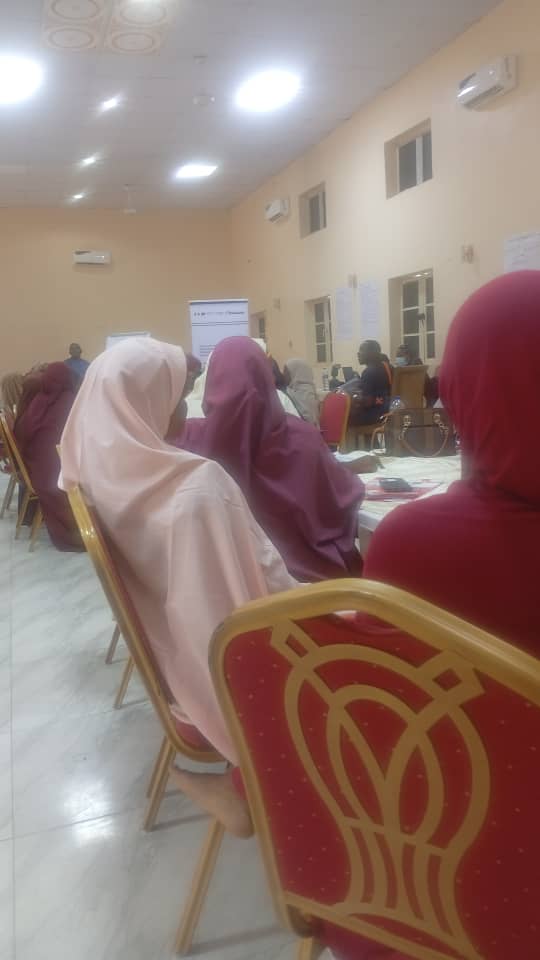


Participants during the opening session of the 4-day Interest-Based Negotiation (IBN) and Community and Social Development Resources Management (CSDRM) Training for Women, organized by Mercy Corps in partnership with IOM and CDD, under the EU-funded CPCRR Programme in Katsina. The training brought together women from Sabuwa, Faskari, Dandume, Safana, Batsari, and Jibia LGAs to promote peace and community resilience.
By Kabir Abasaya
Katsina, Nigeria – November 3, 2025
The international humanitarian organization Mercy Corps, in collaboration with the International Organization for Migration (IOM) and the Centre for Democracy and Development (CDD), has commenced a four-day capacity-building workshop for women from some of Katsina State’s most insecurity-prone local government areas.
The training, themed “Interest-Based Negotiation (IBN) and Community and Social Development Resources Management (CSDRM) for Women,” began on Monday, November 3, 2025, at the Katsina Guest Inn. It is being implemented under the European Union-funded Conflict Prevention, Crisis Response and Resilience (CPCRR) Programme, which seeks to strengthen peace, resilience, and stability across communities affected by violence in Katsina and Zamfara States.
Participants were drawn from Sabuwa, Faskari, Dandume, Safana, Batsari, and Jibia local government areas — regions that have experienced recurring insecurity, banditry, and displacement.
The Project Team Leader, Mr. Philip Ikita, declared the session open with a presentation that provided an overview of the CPCRR Programme. He explained that the initiative builds upon the earlier Conflict Mitigation and Community Reconciliation (CMCR) project, and is designed to tackle the root causes of conflict, strengthen local governance structures, and promote dialogue between citizens and government institutions. Ikita emphasized that the training would equip women with practical skills to contribute meaningfully to peace and community development efforts.
In her welcome address, Senior Programme Officer and Training Coordinator, Ms. Linda Nkechi Emmanuel, highlighted that the opening session aimed to set the tone for the four days of engagement. She said the facilitators intended to welcome participants, establish guiding principles for the training, assess their baseline knowledge through a short pre-test, and provide an overview of the programme’s objectives. The session, she added, was also an opportunity to build a sense of shared purpose among participants and prepare them for an intensive learning experience.
Following the introductory exercises, the participants were introduced to the concept, history, and meaning of negotiation. Facilitators explained how negotiation and mediation serve as vital tools for resolving disputes peacefully and strengthening community bonds. Drawing from Mercy Corps’ approach to peacebuilding, the discussions examined how negotiation frameworks could be adapted to local realities in Katsina’s conflict-affected communities.
Later in the day, participants engaged in interactive simulations designed to help them experience real negotiation dynamics. These exercises encouraged the women to identify their negotiation goals, recognize areas of mutual interest, and draw practical lessons on effective communication and compromise. Through these role-play activities, the women were able to see how empathy, patience, and structured dialogue can transform tense situations into opportunities for cooperation.
Speaking at the session, Mr. Paul Maghul, the Natural Resource Management Adviser (NRM Adviser), urged participants to view negotiation as a vital instrument for community peace treaties. He stressed that “lasting peace can only be achieved when communities choose dialogue over confrontation,” and encouraged the women to take the lessons from the training back to their villages, where they often serve as mediators in domestic and communal disputes.
Subsequent sessions introduced participants to common negotiation models, highlighting the typical pitfalls and assumptions that often hinder successful mediation. Facilitators used real-life examples and group discussions to reinforce learning, ensuring that participants could relate the theories to everyday conflict scenarios in their communities.
The final part of the day focused on the Interest-Based Negotiation (IBN) framework, which breaks negotiation down into phases and emphasizes the creation of mutual value. Trainers explained that successful negotiation depends not only on reaching agreements but also on ensuring that all parties feel respected and fairly treated. Participants reflected on how these principles could be applied in resolving local disputes over land, water, and community resources.
As the first day came to a close, the facilitators guided a reflective review session to summarize major lessons, capture participant feedback, and shape the agenda for Day Two. Breaks for prayers and refreshments during the day provided opportunities for informal dialogue and bonding among participants from diverse backgrounds.
Reporting from the venue, Fasaha Stream correspondent Kabir Abasaya noted that discussions throughout the day revolved around the importance of peace and reconciliation, especially among communities affected by banditry and insurgency.
“All the participants are women drawn from insecurity-prone LGAs of Katsina State — Sabuwa, Faskari, Dandume, Safana, Batsari, and Jibia — and the training focuses on the importance of dialogue and reconciliation among communities, especially those facing insurgency and banditry,” Abasaya reported.
By the end of the session, participants expressed optimism that the skills acquired would enhance their confidence in addressing conflicts peacefully within their communities. Mercy Corps and its partners reaffirmed their commitment to promoting inclusive peacebuilding, collaboration between citizens and government, and sustainable conflict management at the grassroots level.
The training continues through the week, with subsequent sessions expected to cover community resource mapping, social development planning, and practical mechanisms for strengthening local resilience.