
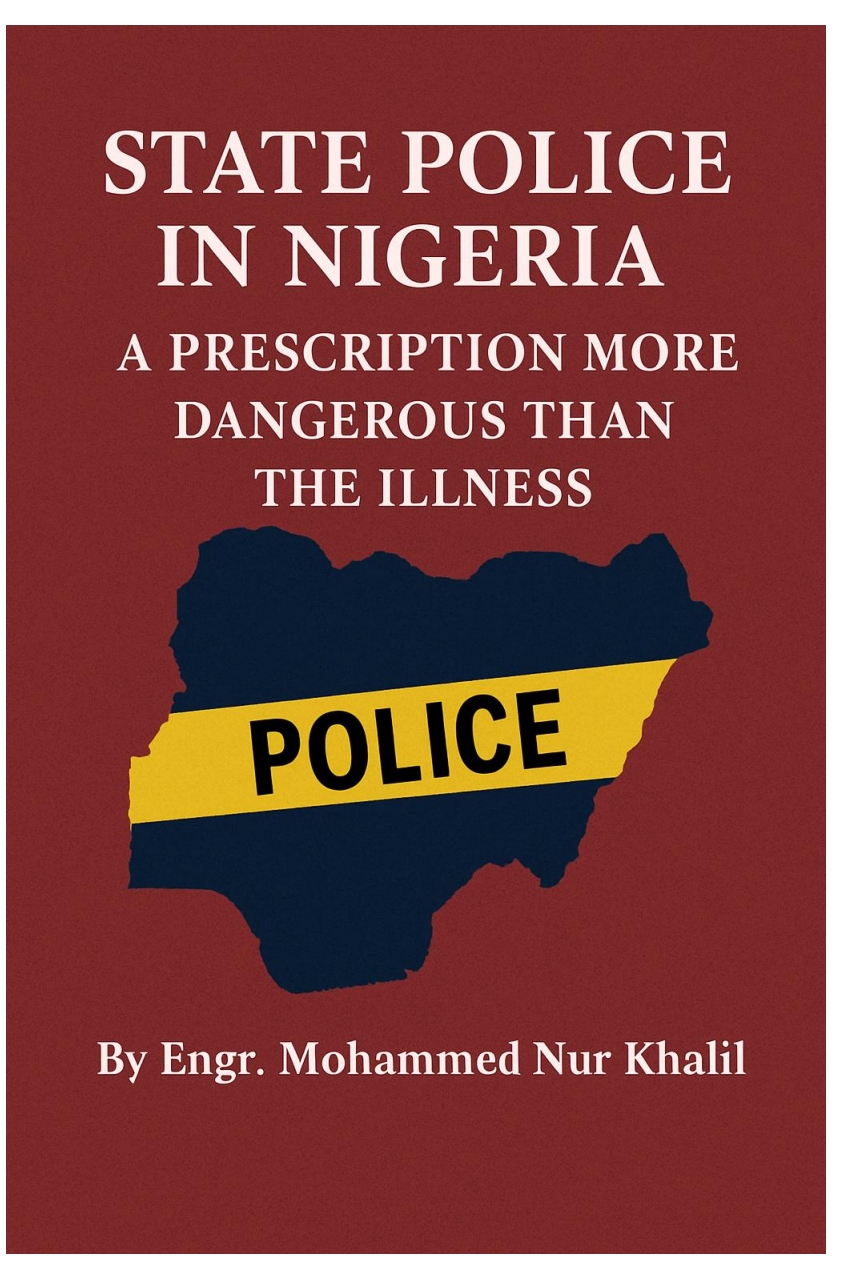

By Engr. Mohammed Nur Khalil
The idea of state police has long hovered at the edges of Nigeria’s security conversation. For years, it appeared as a faint echo in policy debates—periodically invoked in moments of national anxiety, then quietly set aside. But the current wave of insecurity, stretching from insurgent violence to banditry and separatist unrest, has given the proposal an unprecedented surge of political energy. President Bola Ahmed Tinubu’s nationwide address of November 26, 2025—where he declared a security emergency and urged the National Assembly to enable willing states to establish their own police forces—has now thrust the question to the centre of national discourse.
For many Nigerians, exhausted by fear and disillusioned with the capacity of federal security institutions, the proposal offers a tempting promise: a closer, more responsive, and better-localised policing structure. The sentiment is understandable. But Nigeria is not just any federation. It is a complex mosaic of ethnic identities, religious tensions, political rivalries, and historical mistrust. In such an environment, what appears to be a quick fix may unwittingly open the door to deeper and more dangerous fractures.
From my perspective—and that of many security analysts who worry about the country’s fragile political equilibrium—state police represent a prescription that may prove far more dangerous than the illness it seeks to cure.
The Compelling Temptation—and the Hidden Risks
Supporters of state police believe localised security commands will respond faster, understand local dynamics better, and ultimately quell insecurity more effectively. But this assumption glosses over Nigeria’s political realities.
In a system where political competition is often zero-sum, entrusting governors with armed forces answerable primarily to them may create incentives for misuse. Some observers, including respected retired officers like the late Abubakar Tsav, had previously raised concerns that subnational police structures could be vulnerable to political influence. Whether or not one agrees, the fear is not unfounded. Nigeria’s history contains painful examples of security tools being drawn into partisan contests.
Under a state police regime, such risks could multiply. In moments of political tension—especially elections—perceptions alone could be enough to inflame crises.
Moreover, Nigeria’s boundaries are porous and socially intertwined. Crime in one state often spills quickly into another. Thirty-six separate police commands, each with its own political leadership and operational culture, may generate jurisdictional rivalries and slow cooperation—especially in emergencies. In volatile regions, state police units might even face accusations of bias, deepening communal distrust.
These are not abstract worries. They are foreseeable consequences in a federation still struggling to build national cohesion.
The Financial and Operational Burden
Beyond political concerns lies a practical one: cost. Many states already grapple with salary arrears, underfunded hospitals, and deteriorating infrastructure. Policing is expensive—recruitment, training, modern equipment, logistics, and welfare consume vast resources. Creating dozens of new forces without reliable funding risks birthing undertrained, poorly equipped units that may worsen, rather than reduce, insecurity.
The proliferation of weapons—official or otherwise—adds another layer of concern. Weak oversight, in any state, could inadvertently increase the flow of small arms in a country already battling proliferation.
The Real Problem Is Capacity, Not Centralisation
Rejecting the state police model does not mean defending the status quo. Nigeria’s federal policing system faces undeniable challenges—years of insufficient funding, outdated training standards, inadequate equipment, and morale issues rooted partly in welfare conditions.
But if we look closely at the crisis, the core problem is not centralisation; it is capacity.
No policing model—federal, state, or hybrid—can succeed without:
- rigorous recruitment
- modern training
- advanced technology
- reliable intelligence
- adequate welfare
- operational independence and professionalism
Even the most decentralised system will fail if these fundamentals remain weak.
President Tinubu’s ongoing police reforms, including increased recruitment and the redeployment of officers from VIP protection duties to operational units, represent important starting points. However, these must be complemented with deeper institutional restructuring to build a modern, competent, and trusted police force.
A More Responsible Alternative: Reform, Technology, Community Partnerships
A safer and more pragmatic path exists—one that strengthens national unity rather than fragments it.
1. Comprehensive Reform of the Nigeria Police Force
This includes strict, merit-based recruitment, modern training, better welfare, and a renewed focus on professionalism. The Nigeria Police Trust Fund, already provided for in law, offers a direct financing mechanism for equipment, technology, and training—if used effectively and transparently.
2. A Technological Leap Forward
Modern security threats cannot be confronted with outdated tools. Nigeria must invest in:
- long-range drones
- satellite surveillance
- signals intelligence (SIGINT) systems
- integrated biometric and criminal databases
- modern forensic capabilities
These are force multipliers. They enhance the efficiency of every officer—whether federal or local.
3. Community Safety Units as Auxiliaries, Not Armed State Forces
Local involvement in security is crucial, but it must be carefully structured. Community-based outfits can serve as early-warning systems and intelligence gatherers—under federal supervision, with clear legal frameworks, and without operating as parallel armed forces. This preserves unity of command while respecting local knowledge.
This model offers the benefits of local security without the dangers of politicised policing.
Sovereignty and International Engagement
Nigeria faces increasing scrutiny from foreign governments and organisations concerned about insecurity. While some of these comments stem from genuine worry, they sometimes carry tones Nigerians view as intrusive.
The best response is not isolation but confidence.
A Nigeria that reforms its security institutions, adopts modern technology, and engages international partners on its own terms—while retaining command and control—signals its capacity to manage its affairs responsibly. Past experiences, such as the late Gen. Victor Malu’s principled insistence on protecting Nigeria’s autonomy, remind us that sovereignty is strongest when backed by competence, not defensive rhetoric.
Choosing Unity Over Fragmentation
Nigeria stands at a crossroads. The instinct to decentralise policing in the face of rising insecurity is understandable. But understandable is not the same as wise.
State police may appear to offer quick relief, but in a politically charged environment like ours, they carry risks that could destabilise the federation. A more sustainable solution lies in strengthening what we already have—reforming the Nigeria Police Force, leveraging technology, activating the Police Trust Fund, and empowering communities without arming political actors.
The path to lasting security is not fragmentation. It is capacity-building, unity of purpose, and a clear-eyed commitment to national cohesion.
Nigeria’s future stability depends on choosing the safer, more strategic road—one that strengthens the centre while incorporating the periphery, builds competence over time, and ensures that no arm of government—federal or state—wields security power without accountability, professionalism, and national oversight.
Engr. Mohammed Nur Khalil is an engineer, public policy analyst, and former gubernatorial candidate. He is the author of several policy papers on national security and governance.