
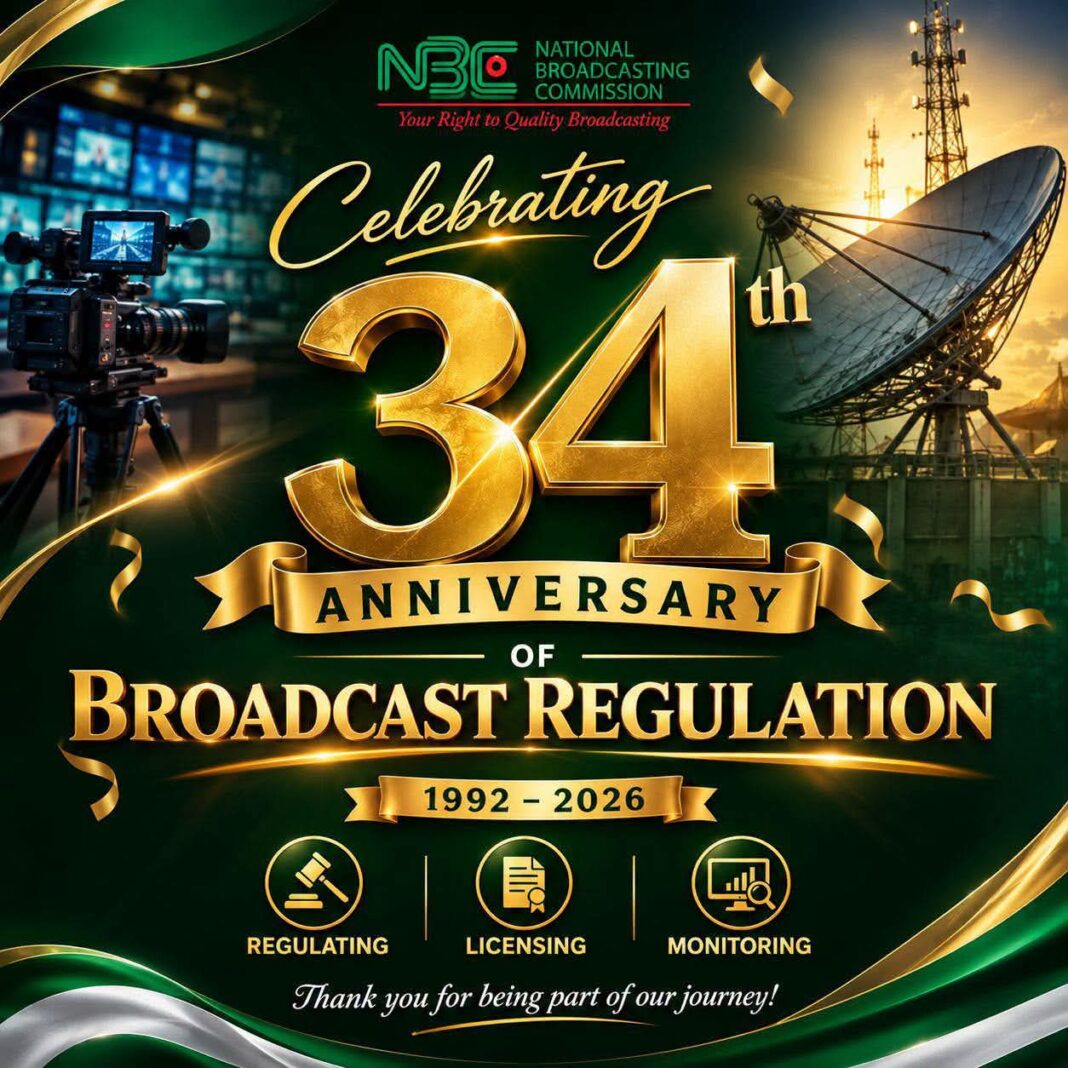

The National Broadcasting Commission (NBC) has marked its 34th anniversary, highlighting more than three decades of broadcasting regulation in Nigeria and its ongoing transformation to meet the demands of the digital age.
Established on August 24, 1992, under Decree No. 38 of 1992, now the National Broadcasting Commission Act, the NBC was created to provide an institutional framework for regulating Nigeria’s broadcasting industry.
The Commission began its journey under its pioneer Chairman, Mr. Peter Enahoro, and the late Professor Tom Adaba, its first Director-General, whose administration laid the foundation for the country’s modern broadcasting regulatory system.
One of the major developments in the Commission’s early years was the licensing of private radio and television stations, which expanded diversity and competition in the Nigerian broadcast industry.
Since then, successive administrations have overseen different phases of the sector’s development. Mallam Nasir Danladi Bako succeeded the pioneer leadership, followed by Dr. Silas Babajiya Yisa. Mr. Bayo Atoyebi later served in an acting capacity before Engr. Abayomi Olaiya Bolarinwa assumed leadership.
Mr. Emeka Nkem Mba subsequently led the Commission during a period characterised by technological convergence and the beginning of Nigeria’s digital migration. He was followed by Mallam Is’haq Modibbo Kawu, under whose tenure digital migration and regulatory reforms remained prominent.
Prof. Armstrong Aduku Idachaba later served as Acting Director-General before Mallam Balarabe Shehu Ilelah assumed leadership as the industry continued to grapple with rapid technological and regulatory changes.
The Commission is currently headed by Dr. Charles Ebuebu, whose administration has placed digital transformation, institutional modernisation, stakeholder engagement and data-driven regulation at the centre of its reform agenda.
The NBC said the broadcasting environment has changed significantly since its establishment, with the industry moving beyond conventional terrestrial radio and television to embrace digital terrestrial television, satellite distribution, streaming services, mobile applications, social media, data analytics and artificial intelligence.
A major milestone in the current transformation is Nigeria’s Digital Switch-Over (DSO) programme, which was nationally launched on June 17, 2026.
The DSO programme is expected to transform television distribution in Nigeria by expanding access, improving signal delivery, promoting competition and creating new opportunities for broadcasters, content producers and advertisers.
The Commission said it is also strengthening its monitoring and enforcement systems, modernising infrastructure, introducing audience measurement mechanisms, retraining personnel and reviewing regulatory frameworks to reflect emerging technologies and changing audience behaviour.
Another major industry initiative was AFRICAST 2025, themed “Navigating the Digital Surge: Building a Resilient African Media Ecosystem for the Future.” The conference brought together stakeholders to examine emerging technological, regulatory and economic challenges confronting the African media industry.
Beyond technological transformation, the Commission said broadcasting must remain connected to Nigerian audiences, culture and stories, noting the growing importance of the creative economy as a source of employment, investment and cultural development.
It also acknowledged the contribution of generations of NBC employees whose professionalism and commitment have sustained the Commission over the years, stressing that staff development and welfare remain critical to its effectiveness.
The Commission, however, recognised that challenges remain, including regulatory compliance, infrastructure deficits, operational costs and workforce capacity.
It said its response to these challenges must continue to be based on stakeholder engagement, transparency, innovation and evidence-based reforms.
From the pioneering leadership of Peter Enahoro and Professor Tom Adaba to the present administration of Charles Ebuebu, the NBC said successive leaderships and stakeholders have contributed to the development of Nigeria’s broadcasting industry.
At 34, the Commission said it stands at another critical stage of its evolution, with digital convergence, data, artificial intelligence and platform regulation expected to shape the next phase of broadcasting.
Despite these changes, the NBC said its fundamental responsibility remains unchanged: ensuring that broadcasting serves the Nigerian public, supports national development and provides a credible platform through which Nigerians can inform, educate, entertain and tell their stories.
The Commission said it was looking to the future with renewed determination to build a modern, technology-driven and globally competitive regulatory institution capable of responding to Nigeria’s rapidly changing media environment.