
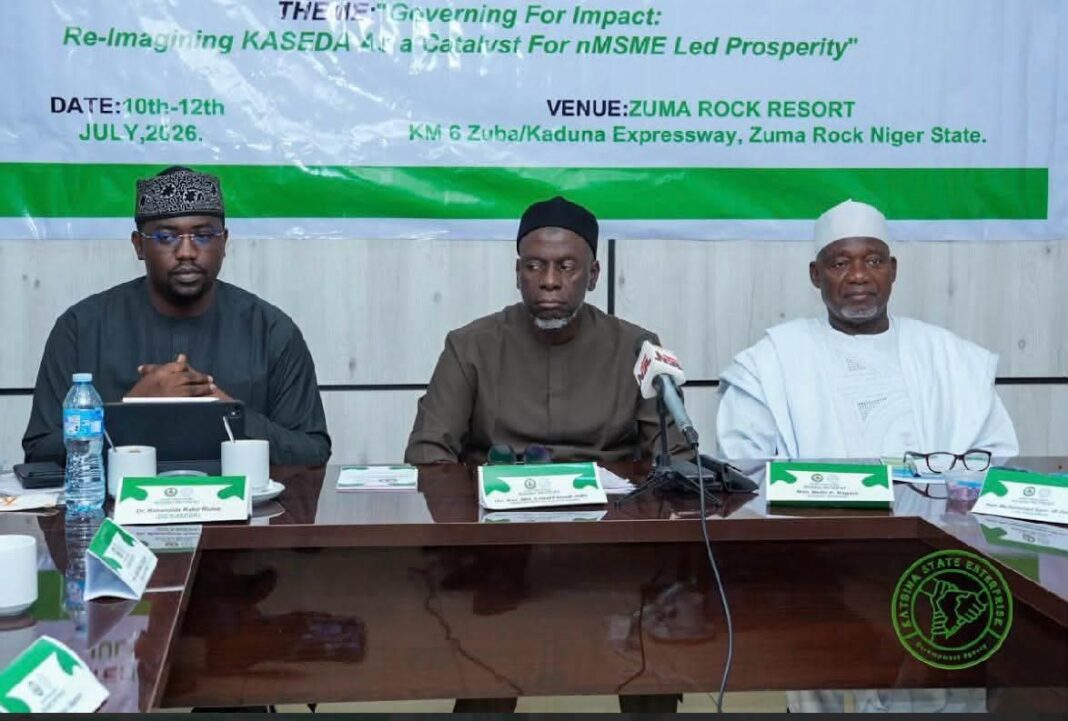

KATSINA – Governor Dikko Umaru Radda has declared that the Katsina State Government is positioning the Katsina State Enterprise Development Agency (KASEDA) to become a leading model for enterprise development across Africa.
The governor made the declaration at the 2026 KASEDA High-Level Board Retreat held at Zuma Rock Resort in Niger State, where he said the agency had reached a defining moment that would shape its direction over the next decade.
Represented by Deputy Governor Faruk Lawal, Radda said the administration’s vision is to build an institution that would not only earn respect within Katsina but also gain national and continental recognition for institutional excellence, innovation and inclusive economic transformation.

“At the end of this retreat, my expectation is that we would have laid the foundation for an institution that is not only respected within the confines of our state but recognised nationally and ultimately across Africa as a model for enterprise development,” he said.
The governor described Micro, Small and Medium Enterprises (MSMEs) as the backbone of every resilient economy, noting that they create jobs, stimulate innovation, strengthen local value chains, reduce poverty and provide opportunities for women, youths, artisans, farmers and emerging entrepreneurs.
He said Katsina had already recorded major achievements in enterprise development, including being named Nigeria’s Best Sub-National SME Development Agency, while one indigenous business won the Most Outstanding SME award at the 2025 National MSME Awards.
Radda, however, said the state’s ambition goes beyond maintaining its current status, stressing that KASEDA should become an institution that other states would study and emulate.
The governor also highlighted the KASEDA Road Corridor Enterprise Infrastructure Programme, which involves mapping roadside businesses across the state’s 34 local government areas to provide government with comprehensive data on the enterprise landscape.

He directed the agency’s management to implement the programme without delay, adding that its success should be measured not by the number of business structures constructed but by improvements in entrepreneurs’ access to finance, productivity, market expansion and livelihoods.
“Government creates the enabling environment, entrepreneurs create the prosperity. KASEDA exists to ensure that the latter is naturally achieved,” he said.
Earlier, KASEDA Director-General, Dr. Babangida Kabir Ruma, said the agency was committed to building an institution that delivers measurable results and serves as a model for enterprise development in Nigeria.
He said entrepreneurs require more than training, stressing the need for access to finance, markets, technology, business advisory services, digital solutions and strategic partnerships.
Ruma urged participants at the retreat to engage in open discussions and remain focused on strengthening the institution to deliver greater value to entrepreneurs across Katsina State.
Delivering the lead presentation, Chief Executive Officer of CRC Credit Bureau, Ahmed ‘Tunde Popoola, described MSME institutions as “critical infrastructure for national economic transformation” rather than mere support programmes.
He argued that sustainable and inclusive prosperity depends on strong sub-national institutions capable of identifying entrepreneurial talent, building business capacity and addressing financing gaps that limit economic growth.
According to Popoola, the performance of an MSME institution should be judged by its ability to transform businesses into engines of innovation, employment, wealth creation and inclusive prosperity, rather than by the number of entrepreneurs trained or loans disbursed.
He noted that with Katsina’s multidimensional poverty rate standing at about 72.7 per cent, according to the 2023 Multidimensional Poverty Index (MPI), enterprise development had become an urgent necessity.
Popoola recommended that KASEDA adopt a “Strategic Modern Model” centred on ecosystem development, policy leadership, investment facilitation, sector and cluster development, innovation, digital transformation and export readiness.
He also called for greater use of technology through initiatives such as a Digital MSME Registry, data-driven targeting, artificial intelligence for credit access and digital market linkages to connect Katsina businesses with e-commerce platforms and export markets.