

The International Institute for Islamic Thought (IIIT), Nigeria Office, in collaboration with the Federal University Dutsin-Ma (FUDMA) Muslim Forum, has launched a Muslim Researchers’ Network aimed at promoting Islamic academic research, intellectual development and social welfare.
The network, launched at an event at FUDMA, is designed to provide a platform for Muslim scholars and researchers to undertake evidence-based research, publish academic works and contribute intellectual solutions to societal challenges.
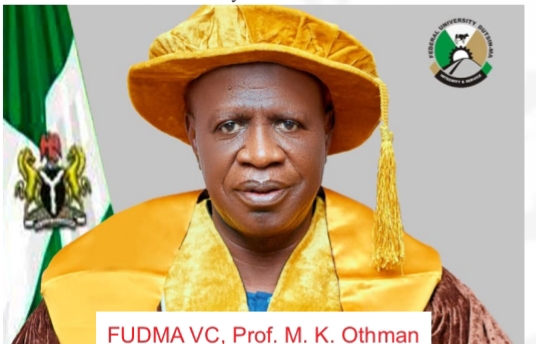
The Vice-Chancellor of FUDMA, Prof. Mohammed Khalid Othman, who launched the network, commended IIIT and the FUDMA Muslim Forum for the initiative, describing it as an opportunity for Muslim intellectuals to combine conventional academic skills with Islamic principles in addressing contemporary challenges.
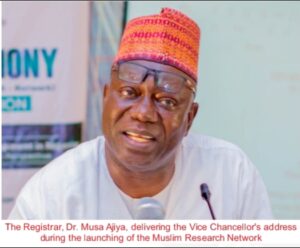
Represented by the University Registrar, Dr. Musa Ajiya, the Vice-Chancellor urged Muslims to embrace creativity, innovation and modernisation without compromising their Islamic values.
He spoke during a programme titled, “Exploring the Nexus Between Governance and Development in Nigeria: Understanding the Relevance of Islamic Political Economic Perspective.”
Prof. Othman said the responsibility for addressing Nigeria’s political and socio-economic challenges should not be placed solely on political leaders, but should also involve citizens and intellectuals.
He appreciated IIIT for establishing an initiative that would groom Muslim intellectuals to apply an integrated approach to solving societal problems.
The Vice-Chancellor also stressed the importance of integrating Muslim lecturers’ knowledge with Islamic methodologies to promote both the religion and the broader interests of humanity.
Speaking on behalf of the National Coordinator of IIIT Nigeria Office, Dr. Saidu Ahmad Dukawa, the Institute’s Director of Orientation and Circulation, Dr. Isma’il Hashim, said IIIT was established in 1981 in the United States by Isma’il Al-Faruqi as a centre for excellence in educational research and Islamic thought.
He said the Institute’s primary interest was to promote evidence-based research at an advanced level, particularly research capable of strengthening education in Muslim societies for the benefit of humanity.
According to him, the Institute also seeks to revive and reform Islamic thought through intellectual findings, while providing Muslim scholars across disciplines with a platform to examine contemporary issues from perspectives compatible with Islamic values.
He said IIIT disseminates research through publications and translations, while also supporting policy recommendations, strategic engagements, scholarships and postgraduate research.
In his welcome address, the Chairman of the FUDMA Muslim Forum and Muslim Researchers’ Network Steering Committee, Prof. Daud Mustafa, said the establishment of the network followed the outcome of a seminar organised by IIIT in collaboration with the Forum in August 2025.
He explained that the network would focus on discussion, publication and sourcing research grants, with the aim of strengthening research and intellectual activities among Muslim scholars.
The Secretary of the Muslim Researchers’ Network Steering Committee, Dr. Abdullahi Abubakar, said the network would seek grants principally from Muslim countries and organisations such as IIIT to support career progression, intellectual development and academic advancement.
He stressed that the network was intended to serve not only the Muslim community but humanity at large.
Presenting the main paper, Prof. Daud Mustafa said Nigeria had enormous economic and human resources but continued to face poverty, corruption, debt, unemployment and insecurity.
He described Nigeria as a multi-ethnic, multi-cultural, multi-religious and multi-party nation with a population of more than 230 million people, and argued that the country’s development challenges required a comprehensive approach to governance.
Prof. Mustafa said stakeholders, including government, the private sector and civil society, had a responsibility to promote good governance through accountability, transparency, access to information, decentralisation and participatory decision-making.
He argued that Islamic development was centred on improving human welfare and bringing people closer to their Creator, while promoting prosperity in both worldly and spiritual terms.
According to him, Islamic political economy examines the relationship between government and the market, including their interaction and consultation, based on Islamic values and principles that promote societal development.
He urged Nigerian political elites to develop a broad consensus around a development agenda capable of addressing the country’s challenges, citing the need for leadership committed to development, justice and good governance.
The event also featured an interactive session during which participants asked questions and sought clarification on issues raised.
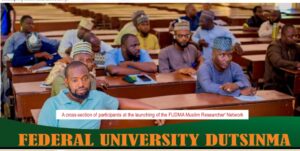
Participants commended IIIT and the FUDMA Muslim Forum for establishing the Muslim Researchers’ Network, describing it as an avenue for strengthening research, scholarship and intellectual engagement.