
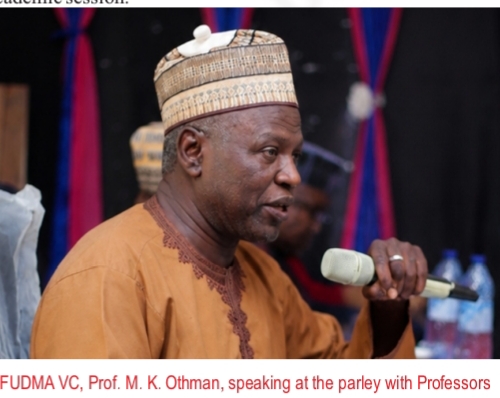

The management of the Federal University Dutsin-Ma (FUDMA), Katsina State, has held an interactive session with professors of the institution to deliberate on the university’s development plans, including the phased relocation of academic activities from the Take-off Campus to the Main Campus.
The parley, which provided an opportunity for professors to make suggestions and raise issues affecting the university, focused on academic planning, staff welfare, transportation, infrastructure, institutional development and the resumption of academic activities at the Main Campus in the 2026/2027 academic session.
Vice-Chancellor, Prof. Mohammed Khalid Othman, said the meeting was intended to serve as a feedback mechanism through which the university management could provide updates, clarify issues and obtain recommendations from the professors.
Othman said the meeting also sought to discuss the implementation of a mentor-mentee system, identify avenues for sourcing research grants and establish collaborations aimed at promoting academic excellence at FUDMA.
The Vice-Chancellor urged the professors to support the planned relocation of faculties to the Main Campus, describing it as a decision that required the cooperation of all members of the university community.
He explained that the initial phase would involve selected faculties and departments, while others would remain at the Take-off Campus.
According to him, 100- and 200-level students in faculties affected by the relocation would continue to receive lectures at the Take-off Campus because of Common and General Studies courses and the availability of Computer-Based Test facilities there.
Othman said the university was also strengthening transportation services between the two campuses, adding that additional buses were being procured to complement the existing fleet.
He said the buses would operate according to scheduled routes and timetables to facilitate orderly transportation for staff and students.
The Vice-Chancellor disclosed that FUDMA currently has approximately 40,000 students and about 4,000 staff, adding that future student admissions would be determined by the available facilities and spaces within the university.
He said the university had taken deliberate steps to address challenges affecting some academic programmes in accordance with regulatory requirements and institutional priorities.
Othman said the university’s immediate priority was to strengthen its existing academic programmes and secure full accreditation for them rather than introduce new programmes.
He identified the proposed Bachelor of Medicine and Bachelor of Surgery (MBBS) programme as one of the university’s high-priority initiatives, saying efforts were underway to secure accreditation for the Health Sciences programmes.
He added that the government had approved the establishment of a hospital to serve as the university’s Teaching Hospital.
The Vice-Chancellor said the MBBS programme would commence with a relatively low number of students once all accreditation requirements had been met, in order to reduce pressure on the university’s existing infrastructure.
He also expressed concern over the commencement of the Livestock Breeding programme without full accreditation, saying management had reviewed the curriculum and submitted revised documents to the National Universities Commission (NUC).
Othman expressed optimism that once approved, the programme would become one of the pioneering programmes of its kind in Nigeria and contribute to national livestock development initiatives.
The professors, according to the bulletin, agreed that priority should be given to securing accreditation for existing academic programmes, particularly the proposed MBBS and Livestock Breeding programmes.
The Vice-Chancellor also disclosed plans to introduce short-term, market-driven professional certificate programmes in emerging areas such as Digital Content Development and related digital skills.
He said the initiative was intended to improve employability and entrepreneurship opportunities without significantly increasing undergraduate enrolment.
The professors supported the phased relocation to the Main Campus, commending management for what they described as strategic planning to address congestion at the Take-off Campus.
They called for continued improvement of infrastructure at both campuses, stronger transportation services, enhanced security and improved staff accommodation.
They also stressed the need for all future developments to be guided by the university’s approved Master Plan.
The professors further suggested the establishment of a Central Jumu’at Mosque at the Main Campus to serve the growing population of staff and students.
Othman said religious, social and recreational infrastructure would continue to be developed in line with the university’s Master Plan and available resources.
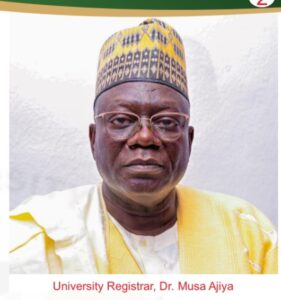
University Registrar, Dr. Musa Ajiya, said arrangements had been made to accommodate essential service personnel during the initial phase of the relocation.
He listed staff of the Student Affairs Deanery, University Health Services, Directorate of Security Services, Directorate of Physical Planning and Works, and other operational units among those whose presence would be required at the Main Campus.
The interactive session resolved that the Take-off Campus would remain fully operational while management continued to improve its infrastructure and learning environment.
It was also agreed that rehabilitation works at the campus should be implemented without delay, inter-campus transportation strengthened through additional buses and scheduled shuttle services, and student admissions aligned with the university’s carrying capacity and available infrastructure.
The meeting further resolved that development of religious, commercial and recreational facilities at the Main Campus should continue in line with the Master Plan, while essential service personnel should be accommodated there during the initial relocation phase to ensure effective service delivery and student support.