
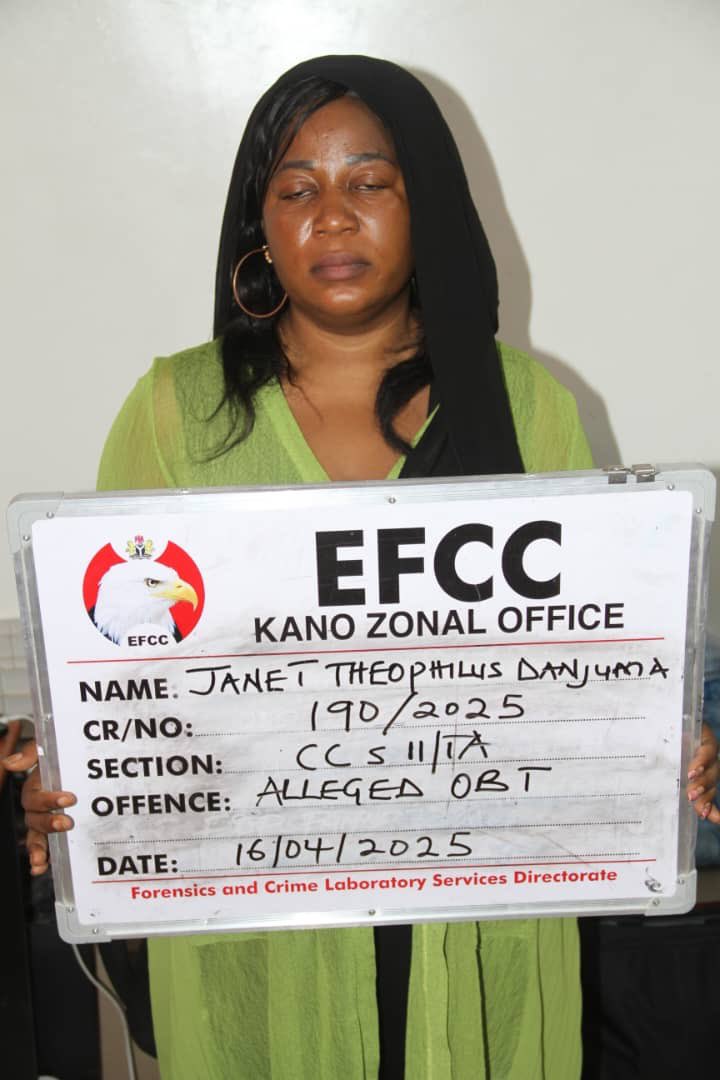

A Federal High Court has sentenced a staff member of Economic and Financial Crimes Commission (EFCC) investigation target, Janet Theophilus Danjuma, an employee of TAJ Bank, to five years’ imprisonment without an option of fine for fraud involving N22.35 million.
The conviction, secured by the EFCC on February 17, 2026, followed findings that Danjuma defrauded a victim by falsely promising to invest the funds in the bank’s Current Account Savings Account (CASA) programme. Investigators traced the money to her personal account, establishing that the funds were diverted for private use.
She was prosecuted under the Advance Fee Fraud and Other Fraud Related Offences Act. The court held that the prosecution proved its case beyond reasonable doubt and accordingly handed down a five-year custodial sentence without the option of a fine.
The anti-graft agency described the conviction as part of its sustained crackdown on financial sector-related fraud. According to the EFCC, the case revealed how legitimate banking products can be manipulated to deceive unsuspecting investors, exposing vulnerabilities within Nigeria’s investment environment.
The commission has repeatedly warned that fraudulent investment schemes continue to inflict heavy losses on Nigerians, with estimates suggesting that victims lose over N1 trillion annually to various forms of financial scams.
Reactions on X (formerly Twitter) were mixed. While many users commended the EFCC for what they described as swift prosecution and accountability, others called on the agency to intensify efforts against high-profile political figures accused of corruption. The debate reflects broader national concerns about corruption, with Nigeria’s corruption challenges estimated in trillions of naira annually, according to recent global assessments.
The EFCC has maintained that it will continue to pursue financial crimes across all sectors, stressing that no offender is beyond the reach of the law.