
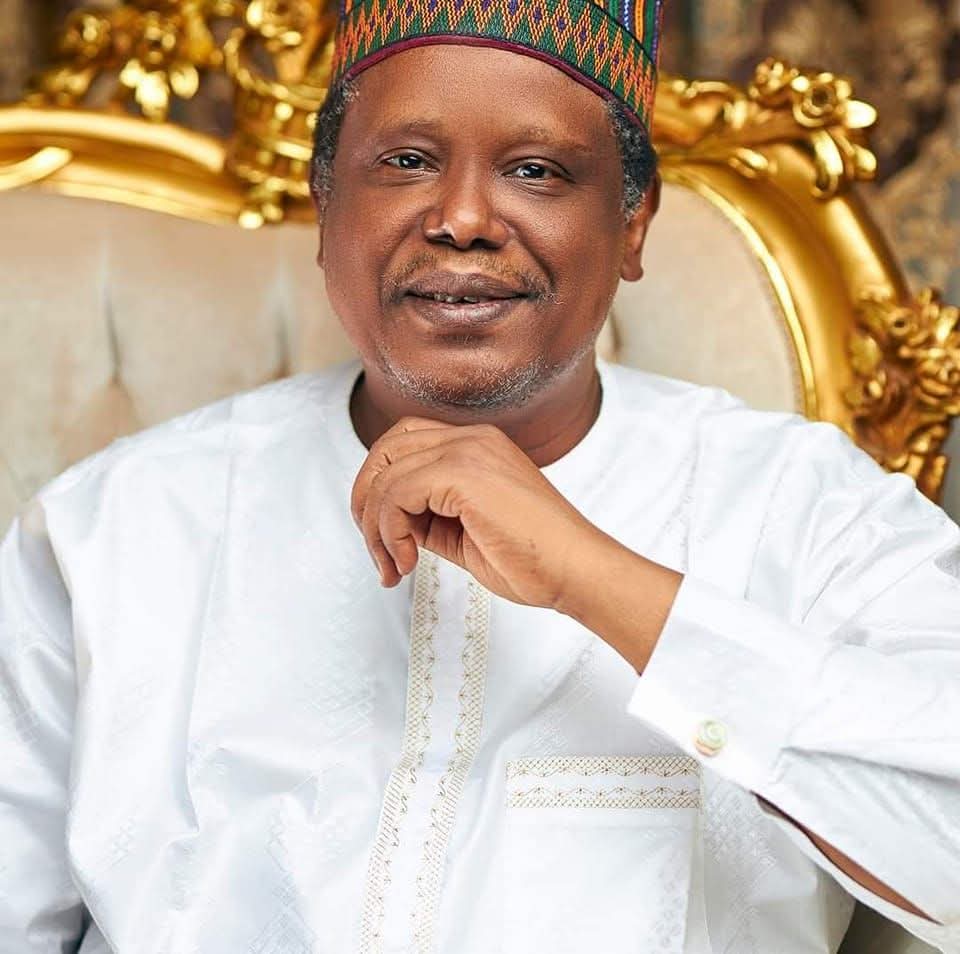

By Engr. Mohammed Nur Khalil
The views expressed in this article are solely those of the author.
I. PROLOGUE: A DISTURBING TURN IN PUBLIC DISCOURSE
In the past few weeks, Nigerians have witnessed two unsettling episodes involving prominent public figures—events that have generated widespread debate about the boundaries of political expression, national loyalty, and responsible leadership.
The first concerns Prof. Joash Ojo Amupitan, SAN, recently appointed Chairman of the Independent National Electoral Commission (INEC), whose 2020 legal brief has been interpreted by many analysts as presenting Nigeria in a manner that could encourage external involvement in its internal security challenges.
The second involves Kabiru Turaki, SAN, former Minister and self-declared National Chairman of the People’s Democratic Party (PDP), who publicly appealed to a foreign president and other nations to “save democracy” in Nigeria.
While each incident has its own context, they appear to form a troubling pattern in which influential elites resort to rhetoric that touches dangerously close to undermining national sovereignty.
In my view, this trend reflects a rising political desperation that demands urgent scrutiny.
Turaki’s remarks—whatever his intentions—were not ordinary partisan commentary. They raise serious concerns about the propriety and implications of calling on foreign governments to intervene in Nigeria’s political affairs.
II. THE TURAKI CONTROVERSY: WHY IT RAISES SERIOUS QUESTIONS
To be clear, Kabiru Turaki is entitled to political views and critiques of government decisions.
However, several elements of his recent statements deserve sober examination.
1. A Call Interpreted as External Appeal
His appeal to “President Trump” and “other developed nations” can reasonably be interpreted as an invitation for external actors to wade into Nigeria’s political processes.
Such statements risk contradicting the spirit of Section 1(2) of the 1999 Constitution, which emphasizes that power in Nigeria must be exercised through constitutional means internal to the country.
2. Reinforcement of Highly Contested Claims
Turaki’s comments referenced narratives about alleged persecution of Nigerian Christians—narratives that have been widely challenged by scholars, security analysts, and interfaith organizations.
By echoing these claims without nuance, his comments risk inflaming domestic tensions and feeding external agendas that have long exploited such narratives.
3. Possible Disregard of Ongoing Legal Proceedings
The convention that produced Turaki’s leadership claim was, according to publicly available court filings, subject to subsisting legal contests, including orders issued on October 31, 2025.
While interpretation of those orders is for the courts, invoking authority from a convention under dispute complicates the legitimacy of any sweeping political pronouncements made from that platform.
In my view, Turaki’s remarks—particularly on a global stage—were ill-advised and potentially damaging to Nigeria’s national image and internal cohesion.
III. THE AMUPITAN PRECEDENT: A TROUBLING ECHO
Turaki’s statements draw uncomfortable parallels with the earlier storm surrounding Prof. Amupitan’s 2020 legal brief titled “Nigeria’s Silent Slaughter: Genocide in Nigeria and the Implications for the International Community.”
The document has been interpreted by many as framing Nigeria in a manner that could justify or encourage international intervention under certain conditions.
The similarities are notable:
- Both men are Senior Advocates of Nigeria.
- Both have occupied positions of national responsibility.
- Both invoked severe characterizations of Nigeria’s internal conflicts.
- Both did so in ways that some observers view as opening rhetorical space for external interference.
Whether or not this reflects a coordinated trend, the perception of such a pattern is worrying and should not be dismissed.
IV. LEGAL AND CONSTITUTIONAL CONTEXT: WHERE THE LINES ARE DRAWN
It is important to clarify that freedom of expression is protected under Section 39 of the Constitution.
However, like all constitutional rights, it comes with limitations.
Speech that appears to encourage external disruption of constitutional authority or that amplifies unverified claims with potential to inflame divisions can attract scrutiny under several legal frameworks, including:
- Sections 50 & 51 of the Criminal Code, which address expressions capable of inciting hatred or disaffection.
- Provisions related to national security, which discourage rhetoric that may undermine public order.
- Cybercrime and digital communication laws, which cover globally broadcast statements capable of causing instability.
This does not mean that either Turaki or Amupitan is guilty of any offence.
Rather, it underscores why such high-stakes rhetoric from national figures should be approached with extreme caution.
V. CONCLUSION: A MOMENT FOR RESPONSIBLE LEADERSHIP
Nigeria is navigating complex political, economic, and security challenges. At such a moment, the country cannot afford high-profile statements that risk inviting external interference, inflaming internal divisions, or undermining public confidence in national institutions. The actions and words of elite figures carry weight. They shape international perceptions, influence domestic sentiments, and can either strengthen or weaken national unity.
It is therefore imperative that:
- Public figures exercise restraint and responsibility;
- Political disagreements remain anchored within constitutional bounds;
- Government institutions respond transparently and firmly to rhetoric capable of harming national stability.
Nigeria deserves a political culture where ambition is pursued without endangering sovereignty, and where public discourse—however heated—remains grounded in patriotism and respect for the constitutional order.
Engr. Mohammed Nur Khalil is a seasoned engineering professional with over four decades of experience. He served as Projects Engineer, Projects Director, and Principal Consultant. He is a registered COREN engineer and ACEN member, who combines technical expertise with public service. He is a philanthropist and a politician. He writes from Katsina.