

By Ahmed Abdulkadir
At a high-profile gathering of Nigeria’s broadcast industry elite, Zamfara State Governor, Dauda Lawal, has been named Governor of the Year for Infrastructure by the Broadcasting Organisations of Nigeria, following what insiders describe as one of the most rigorous selection processes in the award’s history.
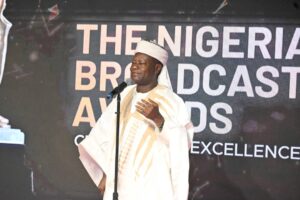
The announcement was made at the BON annual meeting, where leading broadcasters, regulators, and media executives converged to assess governance trends and celebrate excellence across sectors. But beyond the ceremony, it was the meticulous process behind Lawal’s emergence that dominated conversations.
At the heart of the selection was a powerful committee chaired by Dr. Danladi Bako, the Kogunan Sokoto and former Director-General of the National Broadcasting Commission. Known for his long-standing influence in Nigeria’s media and regulatory space, Bako led a panel of seasoned professionals who undertook an exhaustive review of states’ performance records.
Dr. Danladi Bako, Kogunan Sokoto
Multiple entries from across the country were subjected to detailed scrutiny, with the committee examining documented projects, policy implementation records, and measurable impact on citizens’ lives throughout the review period. The process, sources say, went beyond surface-level claims, relying instead on verifiable data, comparative assessments, and layered evaluations designed to isolate genuine performance from mere publicity.
Within that framework, Zamfara’s submission stood out.
Despite its long-standing security challenges and developmental setbacks, the committee found that Lawal’s administration had demonstrated a consistent push toward rebuilding critical infrastructure. Road networks, urban renewal initiatives, and public service facilities were highlighted as evidence of a deliberate effort to reposition the state. Observers at the meeting noted that what distinguished Zamfara was not just the visibility of projects, but the coherence of execution and their alignment with broader recovery goals.

Deliberations by the Bako-led panel reportedly centred on impact, sustainability, and reach—key indicators that ultimately tipped the balance in Zamfara’s favour. By the time the final decision was reached, there was said to be a strong consensus among committee members that the state’s infrastructure drive had set it apart from its peers.
The BON gathering itself provided more than just an awards platform. It became a forum for reflecting on the role of credible institutions in shaping public accountability, with speakers stressing the need for transparency and professionalism in recognising performance. The integrity of the selection process, anchored by Bako’s committee, was repeatedly cited as a benchmark for future assessments.
For Lawal, the recognition marks a defining moment in his administration’s narrative—one that signals a shift from a state often associated with crisis to one gaining national attention for reconstruction and development.
As the curtains fell on the BON meeting, the message from industry stakeholders was clear: in an era of growing public scrutiny, only measurable impact—not rhetoric—will continue to earn national recognition.