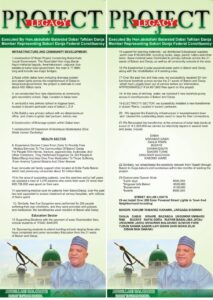
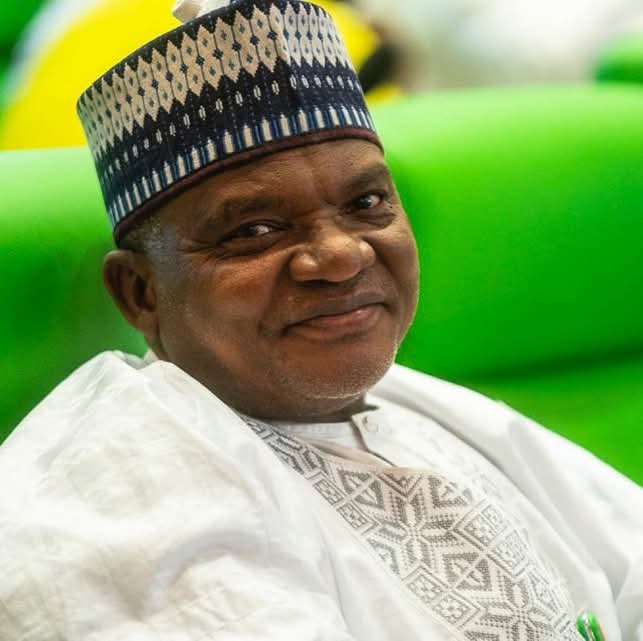

Hon. Abdullahi Balarabe Dabai, member of the House of Representatives representing Bakori/Danja Federal Constituency, has recorded a wide range of constituency interventions in infrastructure, health, education, water supply and electricity within two and a half years in office.
A summary of projects executed across Bakori and Danja Local Government Areas shows investments in road construction, school infrastructure, healthcare delivery and basic utilities, reflecting a growing emphasis by federal lawmakers on constituency projects as a measure of performance.
Among the major infrastructure projects attributed to the lawmaker is the construction of a 17.8-kilometre road linking Bakori to Kafur Local Government Area, including two bridges. Internal roads with drainage and street lighting were also constructed in Dabai town, alongside additional drainage works aimed at addressing seasonal flooding.
Education-related interventions include the construction of new classrooms at Community Girls Secondary School, Danja, primary schools in Gagawa town and Kurami/Yankwani ward of Bakori Local Government Area, as well as a six-classroom primary school with offices and furniture in Gidan Dan-Iya, Kattu ward. Classroom blocks were also built at Islamiyya Makarantar Zikra Sheikh Usman Danfodiyo.
In the health sector, Dabai facilitated medical outreach programmes involving specialist doctors from Zaria, who provided free medical services to residents of the constituency. Records indicate that over 350 surgeries were carried out for conditions such as hernia, fractures, appendicitis and hydrocele, while free medication was distributed to patients suffering from malaria, typhoid and anaemia. In total, 1,276 patients reportedly benefited from medical interventions over the period under review.
Other health-related projects include the renovation of a dialysis support clinic at Kofar Fada, Bakori, sponsorship of patients for specialised medical treatment, and free eye surgeries for 200 residents, who also received corrective glasses and medication.
Speaking on the interventions, Dabai said the projects were driven by basic needs identified across the constituency.
“Our focus has been on projects that directly touch the lives of ordinary people—healthcare, education, water and access roads. These are needs that communities themselves consistently raise,” he said.
Water supply projects executed within the two-and-a-half-year period include the installation of two solar-powered water points in Bakori and Danja, rehabilitation of four existing facilities, and the repair of 83 non-functional hand-pump boreholes across the 21 wards of the constituency at a cost of about ₦24.6 million. Five new borehole pumps were also installed in selected communities.
In the electricity sector, a new transformer was installed in Dutsen-Reme, Kurami/Yankwani, while electricity infrastructure was repaired in Kwantakwara town, including the settlement of outstanding debts owed to the power utility. Transformers and power lines were rehabilitated in several communities across Bakori and Danja, and over 200 solar-powered street lights were installed in towns and neighbourhoods within the constituency.
Political analysts note that Dabai’s interventions align with a broader trend in Nigeria’s National Assembly, where lawmakers increasingly prioritise constituency projects amid public pressure to demonstrate tangible impact beyond lawmaking and oversight.
“While legislators are constitutionally tasked with lawmaking and oversight, constituency projects have become a major yardstick for evaluating performance, especially at the grassroots,” said a political analyst in Katsina State. “The challenge is balancing these interventions with effective legislative engagement at the national level.”
Critics, however, argue that the focus on projects often blurs the lines between executive and legislative responsibilities, while supporters contend that such interventions help bridge development gaps in underserved communities.
Dabai, responding to such concerns, said constituency projects should complement—not replace—legislative duties.
“Representation goes beyond debates in Abuja. It also means ensuring that the dividends of democracy are felt in communities that have long been neglected,” he said.
The projects were executed across both Bakori and Danja Local Government Areas within a period of two and a half years, according to documentation released by the lawmaker’s Media Aide, Ismael Bako Guga.