

By Muhammad Abubakar
Some people leave home and gradually become strangers to the places that shaped them. Others travel far, occupy important positions and acquire national and international recognition, yet somehow remain deeply connected to where they began.
Engr. Muttaqha Rabe Darma, PhD, belongs to the latter category.
As a friend who has watched his journey over the years, I have always found one quality particularly striking: his uncommon attachment to Katsina. For Darma, Katsina has never been merely the place where he was born. It has remained part of his identity, his intellectual interests, his friendships, his political outlook and his understanding of community.
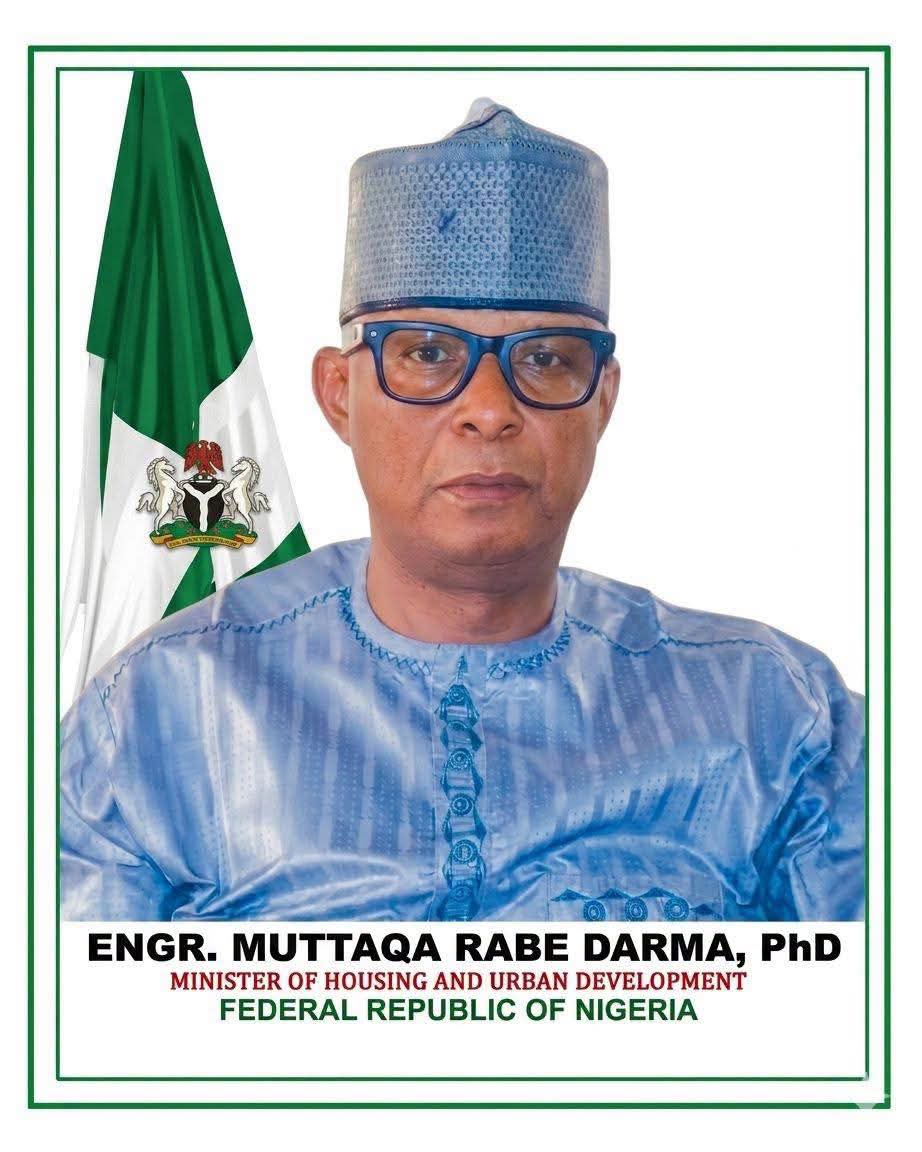
His recent appointment as Minister of Housing and Urban Development provides an appropriate moment—albeit belatedly—to reflect on the journey of the man and the ideas that have accompanied him from the ancient heart of Katsina to the national stage.
A son of Cikin Birni
Darma was born on 23 July 1966 in Darma Quarters, within the ancient inner city of Katsina, popularly known as Cikin Birni.
Growing up in that environment meant being exposed to a society where traditional institutions, culture, community relationships and modern influences existed side by side. It was a cosmopolitan upbringing in its own distinctive way.
Perhaps that explains something about Darma’s personality. His education and career eventually took him far beyond Katsina, but the wider his world became, the more conspicuous his attachment to home seemed to grow.
He attended Rafindadi Primary School and Government Day Secondary School, K/Yandaka, before proceeding to Bayero University, Kano, where he obtained a Bachelor of Engineering degree in Mechanical Engineering in 1989.
His thirst for knowledge did not end there. He subsequently obtained an MBA from Bayero University and a master’s degree in Production Engineering from the University of Benin.
That combination of engineering, management and production training would later prove useful in a career that moved between academia, politics, administration and public-sector management.
More than an engineer
It would be difficult to describe Darma simply as an engineer.
Over the years, he has been an academic, youth leader, grassroots politician, administrator, public servant, author and development thinker.
Long before his appointment to the Federal Executive Council, he had participated in youth and grassroots political activities and advocated issues concerning local representation and community development.
His political activities were accompanied by a strong intellectual interest in governance and the future of Katsina.
He has written extensively on governance, development, leadership, youth, peace and the prospects of Katsina State. Among his works are Pathways to Greatness: The Katsina State of the Future, Pathway to Good Governance and Foundation for Greatness.
His writings demonstrate something that those who know him have often observed: he does not see political participation and intellectual engagement as mutually exclusive.
For him, politics is ultimately supposed to produce ideas, institutions and improvements in people’s lives.
The Yar’Adua years
A significant chapter in Darma’s public career was his association with the administration of the late Umaru Musa Yar’Adua as Governor of Katsina State between 1999 and 2007.
Darma served as a commissioner during that period and became part of the political and administrative establishment of what remains one of the most consequential periods in Katsina’s modern political history.
His relationship with Yar’Adua has continued to occupy an important place in his intellectual reflections.
He has written about lessons he learned from the late statesman, including What Umaru Musa ‘Yar’Adua Told and Taught Me: Some Lessons on Leadership, as well as an insider’s account of the Yar’Adua administration in Katsina.
That continued engagement tells us something about Darma. For him, political experience is not simply something to be remembered; it is something to be studied for lessons that may be useful to future generations.
From Katsina to the national stage—and back home
In November 2008, Darma was appointed Executive Secretary of the Petroleum Technology Development Fund (PTDF), a position he held until 2012.
It was an important transition from state politics to national public service. At PTDF, he operated within a federal institution responsible for developing human capacity and technological expertise for Nigeria’s petroleum industry.
After leaving PTDF, however, Darma did something that I consider particularly revealing about his character.
He came home.
For someone who had occupied a prominent federal position and could easily have remained in Abuja, returning to Katsina in 2012 was significant. And he did not simply return as a former federal official. He remained connected to the people, friends, political associates, community figures and ordinary citizens who constituted his social world.
This is one of the things that distinguishes him in my view.
Many public officials gradually become detached from their original communities as their careers progress. Darma’s experience has been different. His professional journey expanded his horizons without displacing his roots.
He travelled. He served. He acquired national exposure. But he came home.
Katsina as an intellectual project
Perhaps the strongest evidence of Darma’s attachment to Katsina is not where he lives or whom he visits, but the amount of intellectual energy he has devoted to the state.
He has repeatedly returned to the question of how Katsina can achieve sustainable development.
His writings examine governance, education, development financing, political leadership, institutional performance and the future of the state. He has also offered policy ideas to political leaders on how Katsina’s developmental challenges might be addressed.
One may agree or disagree with particular ideas, but the consistency of the engagement is difficult to overlook.
Katsina is not simply a political constituency for Darma. It appears to be a continuing intellectual concern.
That is why I have sometimes wondered whether his attachment to the city should really be described as an “obsession”, as some friends jokingly do.
Perhaps it is better described as loyalty.
A changing political landscape
Darma’s career has also spanned several generations of Katsina’s political development.
He belongs to a generation that witnessed the political transformation of the late 1980s and 1990s, participated in the political environment of the Yar’Adua years and subsequently became part of the wider national political and administrative establishment.
At the same time, he has remained interested in younger people, education, skills and the institutional questions that will determine the future of Katsina.
This gives him a perspective that crosses generations.
Katsina itself is changing. Its young population is increasingly educated and connected through technology and social media. Expectations of government are changing, and questions of competence, accountability, institutional performance and development are becoming increasingly important.
The challenge for the next generation of leaders is therefore not simply to inherit political structures but to make them work better.
This is a theme that runs through much of Darma’s intellectual work.
The new national assignment
On 24 April 2026, President Bola Ahmed Tinubu swore in Darma as Minister of Housing and Urban Development after his confirmation by the Senate.
The appointment added another significant chapter to an already varied career.
Housing is one of Nigeria’s most pressing development challenges. The country’s rapidly growing urban population, housing deficit, land administration problems and infrastructure needs require more than the construction of houses. They require planning, financing, institutional reform, private-sector participation and innovative approaches to urban development.
In many respects, the portfolio provides an opportunity for Darma to bring together several strands of his experience—engineering, management, public administration, political engagement and his long-standing interest in development.
His previous experience as Commissioner for Works, Housing and Transport in Katsina is also particularly relevant to his new responsibility at the federal level.
A responsibility, not merely an honour
As a friend, I see his appointment less as an occasion for celebration alone than as a responsibility.
National appointments confer visibility, but they also impose expectations.
For Darma, the challenge is to translate the confidence placed in him into tangible results—better housing delivery, stronger institutions, improved land administration, more effective partnerships and policies that genuinely expand access to decent and affordable housing.
His success will ultimately be measured not by the title of Minister, but by what Nigerians can point to and say was achieved during his stewardship.
And that is perhaps where his lifelong interest in ideas becomes important.
The engineer in him understands systems.
The administrator understands institutions.
The politician understands people.
And the intellectual in him has spent years thinking about development and governance.
The opportunity now is to bring these qualities together in the service of the country.
A man who never forgot home
For me, however, the most remarkable part of Darma’s story remains simpler than all the titles and positions.
He never forgot home.
From Darma Quarters in Cikin Birni to Bayero University, from Katsina politics to PTDF and back to Katsina, and now to the Federal Executive Council, he has carried his roots with him.
His exposure expanded his world, but it did not erase his beginnings.
That is worth celebrating.
Katsina gave him his first environment, his formative experiences and his earliest understanding of society. The wider world gave him education, exposure and opportunities to serve. Yet, through it all, Katsina remained a recurring reference point.
Perhaps that is why he has written so much about the state’s future. Perhaps it is why he has maintained relationships with people across different social and political backgrounds. And perhaps it is why, even after occupying important positions outside the state, he chose to return home.
Political offices are temporary. Governments change. Titles come and go.
But one’s relationship with the people and community that shaped one’s life can endure.
That, more than any appointment, is the part of Muttaqha Rabe Darma’s story that I find most admirable.
From friend to minister
So, belatedly, I join the many people congratulating my friend, Engr. Muttaqha Rabe Darma, PhD, on his appointment as Minister of Housing and Urban Development.
I do so not merely because he has attained another high office, but because his journey offers an encouraging lesson about public service.
A young man from the heart of Katsina became an engineer. The engineer became an academic and youth leader. The youth leader became a politician. The politician became an administrator. The administrator became a federal public servant. The public servant returned home, continued thinking and writing about development, and eventually returned to national service as a minister.
It is a long journey.
But perhaps the most beautiful part is that, despite how far he has travelled, he has continued to carry Katsina with him.
He rose.
He travelled.
He served.
He returned home.
And he stayed connected.
Now, with a new national responsibility before him, the hope is that he will once again turn experience into service and ideas into results.
For a man who has spent much of his life thinking about what makes communities prosper, the Ministry of Housing and Urban Development offers a fitting new chapter.
And for those of us who have known him as a friend, it is both a source of pride and a reason to wish him well.
Congratulations, Engineer Muttaqha Rabe Darma. May this new chapter of your journey bring honour to you, greater opportunities for service to Nigeria, and—perhaps inevitably—more reasons for you to remain obsessed with Katsina.