
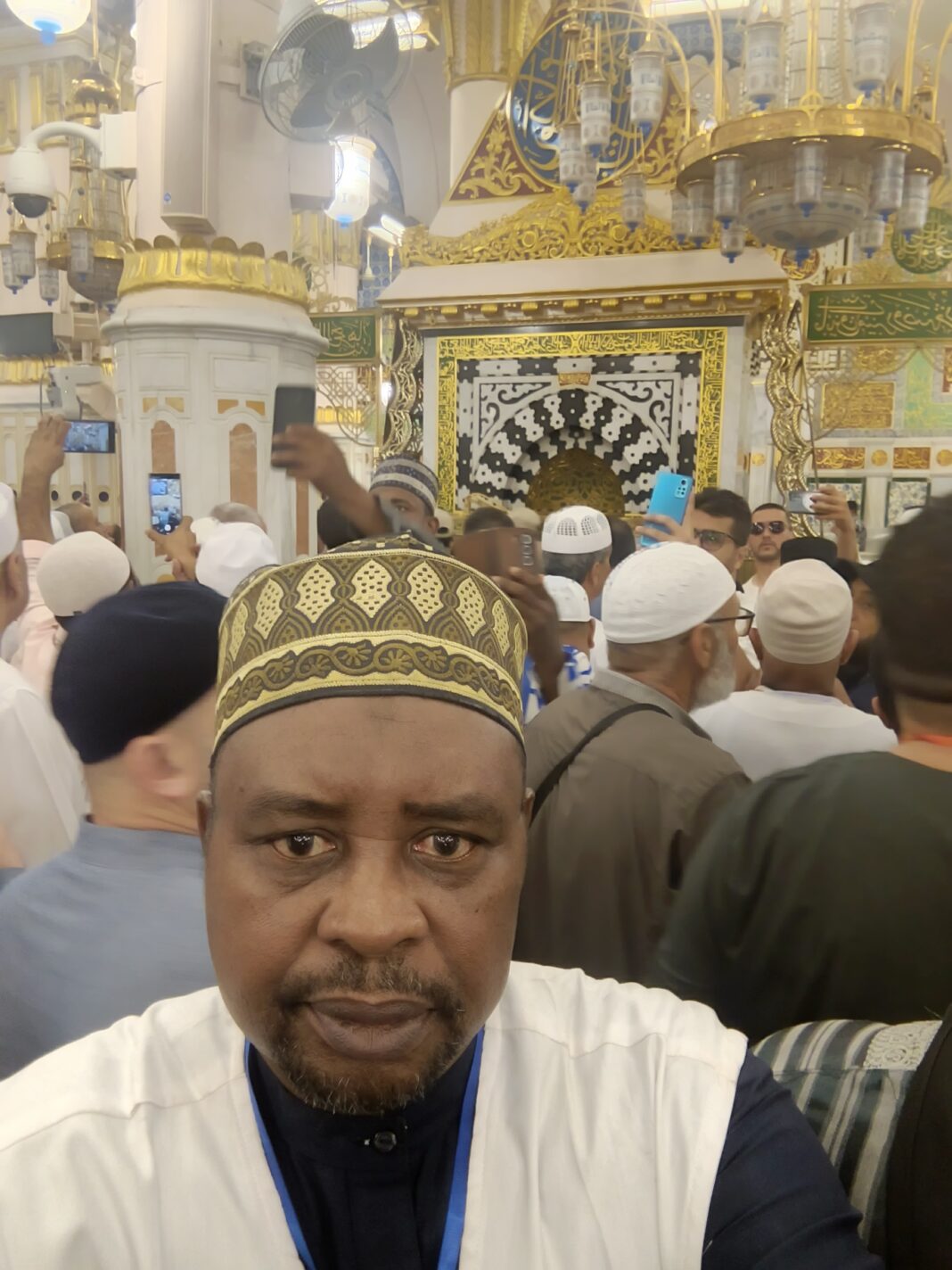

There are moments in life when history suddenly feels alive — not as stories read in books or sermons heard from scholars, but as something one can almost touch, feel, and breathe.
For me, that moment came in Madinah.
Since arriving in the blessed city yesterday as part of the 2026 Hajj pilgrimage, I have experienced what is perhaps the most spiritually fulfilling and emotionally rewarding phase of the journey so far. Unlike Makkah, where the atmosphere is dominated by the intensity and movement of Hajj rites, Madinah carries a different feeling altogether — calmer, softer, deeply reflective, and profoundly emotional.
To every pilgrim, traveling to Madinah is not merely a stop during Hajj. It is a spiritual homecoming to the city of the Holy Prophet Muhammad (SAW), a place where Islam flourished, where revelation shaped humanity, and where every street, mountain, and mosque carries memories of sacrifice, faith, and devotion.
Naturally, my very first destination upon arrival yesterday was the resting place of the Holy Prophet Muhammad (SAW).
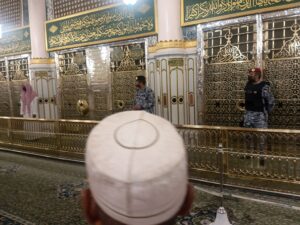
Standing before the sacred chamber where the Prophet (SAW) is buried alongside his closest companions, Abu Bakr (RA) and Umar ibn Khattab (RA), is an experience difficult to adequately describe in words. Millions of Muslims across centuries have longed for that moment — to stand in the city he loved, to send salutations upon him directly, and to reflect upon the sacrifices he endured in delivering the message of Islam.
Madinah itself became the cradle of the first Islamic state after the Prophet’s migration (Hijrah) from Makkah in 622 CE. It was here that the Muslim community was built on faith, brotherhood, justice, and sacrifice. The Prophet’s Mosque, Masjid an-Nabawi, became not only a place of worship but also a center of leadership, education, diplomacy, and community life.
Visiting the Prophet’s grave is therefore not an act of worship directed toward the grave itself, but a deeply spiritual visit rooted in love, respect, and gratitude toward the Messenger of Allah (SAW).
Today’s journey through the historical sites of Madinah deepened those emotions even further.
One of our first stops was Mount Uhud, one of the most emotionally significant landmarks in Islamic history. The mountain witnessed the famous Battle of Uhud, fought in 625 CE between the Muslims and the Quraysh of Makkah. It was here that many companions of the Prophet (SAW), including his beloved uncle Hamza ibn Abdulmuttalib (RA), were martyred.
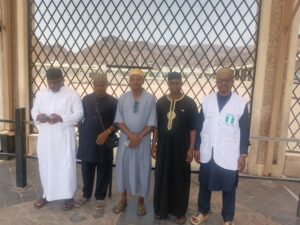
The Prophet (SAW) is reported to have said: “Uhud is a mountain that loves us and we love it.”
Standing before the mountain today, one could almost imagine the courage, pain, confusion, and sacrifice that unfolded there centuries ago. Pilgrims visit Uhud not merely to see a mountain, but to remember the lessons of obedience, patience, sacrifice, and steadfastness in times of difficulty.
From Uhud, we proceeded to Masjid Quba — the first mosque built in the history of Islam.
Constructed shortly after the Prophet’s migration from Makkah to Madinah, Masjid Quba occupies a unique position in Islamic history. The Prophet (SAW) himself participated in its construction and frequently visited the mosque to pray there. Islamic tradition highly recommends visiting and praying in Quba Mosque, as the Prophet (SAW) said that performing two raka’ats there carries the reward of an Umrah.
Even today, despite its modern expansion and architectural beauty, Masjid Quba still radiates simplicity and serenity.
Our journey then continued to the famous Masjid al-Qiblatain — the Mosque of the Two Qiblas.
The mosque derives its name from one of the most important turning points in Islamic history. It was here that the command was revealed to the Prophet Muhammad (SAW) to change the direction of prayer (Qibla) from Jerusalem to the Ka’abah in Makkah. Historical accounts state that while leading prayer, the Prophet (SAW) received revelation and immediately changed direction during the prayer itself, with the congregation following him.
That singular moment symbolized the emergence of a distinct Islamic identity and strengthened the spiritual connection between Muslims and the Ka’abah.
Walking through the mosque today, one cannot help but reflect on how revelation transformed not only the direction of prayer but the course of human history itself.
Perhaps one of the most fascinating visits of the day was to the area commonly known as the “Seven Mosques” (Sab’u Masajid).
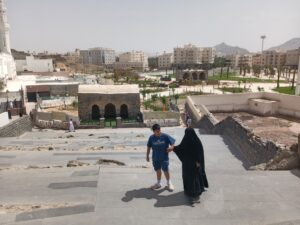
The site is associated with the Battle of the Trench (Ghazwat al-Khandaq), when the Muslims defended Madinah against a coalition of enemy tribes. Among the mosques there is one believed to mark the place where the Prophet Muhammad (SAW) stayed and prayed for three days, earnestly supplicating to Allah for victory during the difficult siege. Historical narrations mention that divine help eventually came, changing the course of the battle in favor of the Muslims.
Nearby are small mosques associated with some of the Prophet’s greatest companions — Salman al-Farisi (RA), Abu Bakr (RA), Umar ibn Khattab (RA), and Ali ibn Abi Talib (RA). Salman al-Farisi, the Persian companion credited with suggesting the trench strategy, occupies a special place in the history of that battle.
Though modest in size, the mosques stand as enduring reminders of the unity, sacrifice, consultation, and resilience that defined the early Muslim community.
Yet, despite all these deeply moving visits, nothing prepared me for the emotional experience of entering the Raudah.
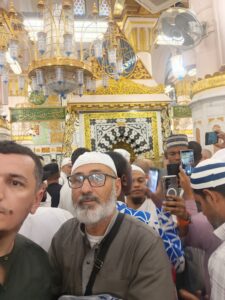
Located within Masjid an-Nabawi between the Prophet’s house and his pulpit, the Raudah is regarded as one of the most sacred places in Islam. The Prophet (SAW) himself said:
“Between my house and my pulpit is a garden from the gardens of Paradise.”
For this reason, pilgrims from every part of the world long for the opportunity to pray there, even if only briefly.
As I entered the Raudah today, an overwhelming feeling of serenity descended upon me — a quietness unlike anything I had experienced before. Despite the crowds, despite the movement of thousands of worshippers, there was a strange stillness in the heart.
It was sobering.
The atmosphere carried a sense of humility and reflection difficult to explain. One becomes deeply conscious of one’s shortcomings, one’s hopes, one’s prayers, and one’s mortality. The world outside suddenly feels distant.
There, I was privileged not only to perform nawafil prayers, but also Asr prayer and even a funeral prayer.
For many pilgrims, praying two raka’ats in the Raudah represents the fulfillment of a lifelong dream. It is not merely about occupying a physical space; it is about feeling spiritually connected to the legacy of the Prophet Muhammad (SAW), whose teachings transformed humanity.
As the day came to an end, one truth became increasingly clear to me: Madinah is not merely visited with the eyes.
It is experienced with the heart.