
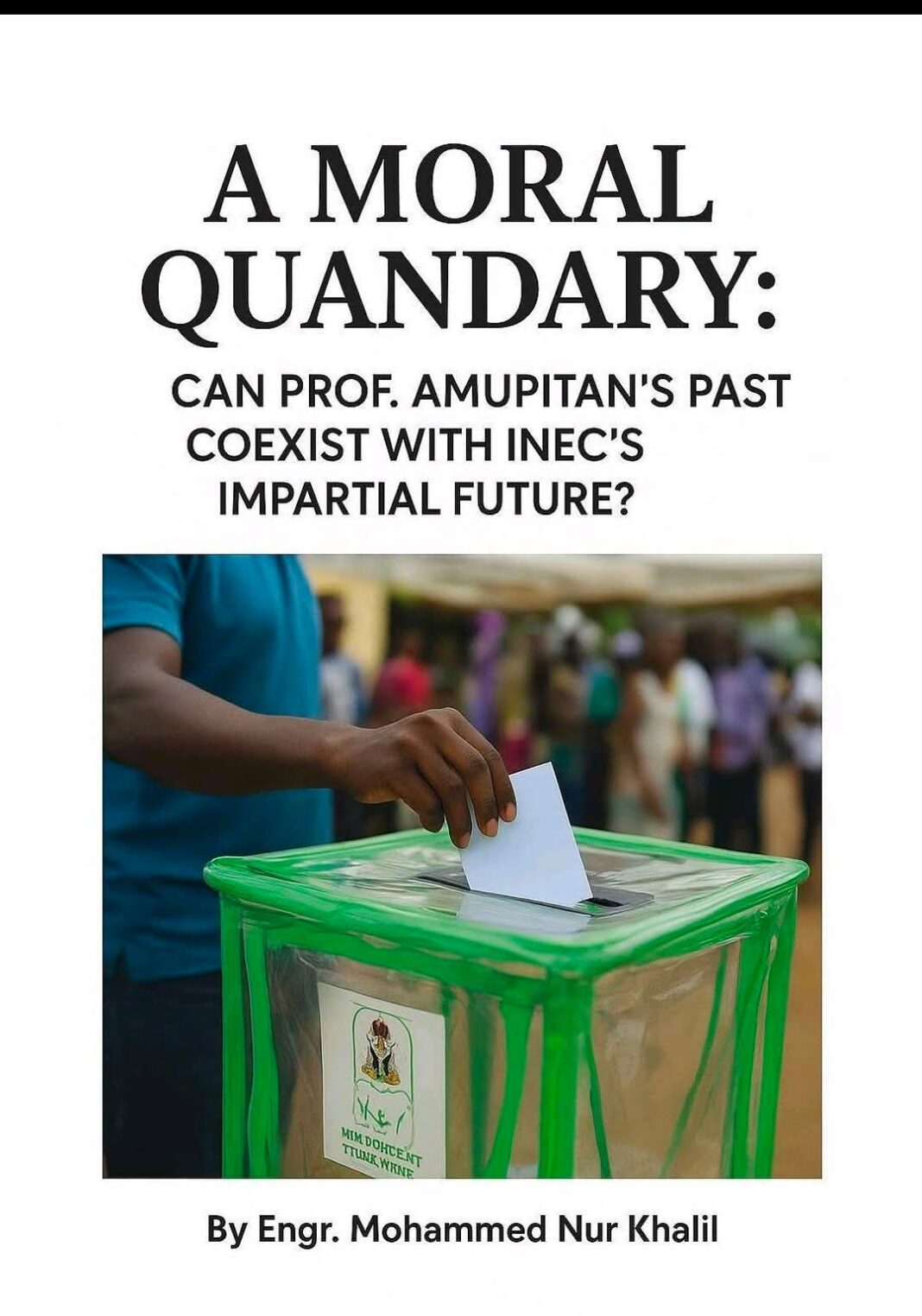

By Engr. Mohammed Nur Khalil
I. Prologue: The Burden of Trust
In moments of national decision, it is not only policies but character that are tested. Recently, the world turned its eyes to Nigeria amid U.S. President Donald Trump’s threats of military intervention over an alleged “Christian genocide.” Central to the controversy is a 2020 report titled Nigeria’s Silent Slaughter, authored by Prof. Joash Ojo Amupitan (SAN), now the Chairman of the Independent National Electoral Commission (INEC).
The question before the nation is not merely procedural: Can a man whose past writings called for the prosecution of his own government and even foreign military action, now serve as a custodian of electoral integrity? The answer will define not just the credibility of elections, but the moral tone of our democracy.
II. A Past That Speaks Loudly
Prof. Amupitan’s brief was more than academic. It accused the Nigerian state of complicity in crimes against humanity and framed insecurity through the prism of religious and historical grievances. Most strikingly, it recommended international intervention, effectively challenging the nation’s sovereignty.
This is not a matter of scholarly opinion; it is a moral statement that continues to resonate, particularly now that its author holds one of the most sensitive offices in Nigeria. The tension between his past assertions and his present responsibilities is profound, and it raises an essential question: Can history, once publicly declared, be reconciled with impartial stewardship?
III. The Ethical Dilemma
To understand the stakes, we must separate analysis from philosophy.
A. Oversimplification and Its Consequences
Violence in Nigeria is complex, shaped by economic, social, and political factors, not a single religious project. Reducing it to a monolithic narrative risks moral error: to see one group’s suffering while rendering another invisible is to distort the human story.
B. The Weight of Historical Framing
Invoking the 19th-century Sokoto Caliphate to explain contemporary insecurity risks moral distortion. History informs conscience, but it does not absolve us of the ethical responsibility to see the present with clarity. To generalize an entire ethnic group’s responsibility for modern crimes undermines unity and trust—the very foundations an INEC Chairman must uphold.
C. The Imperative of Impartiality
Leadership in a democracy is a covenant of trust. The past is not erased, but the moral question remains: Can one who once perceived the government as an adversary now act as a neutral arbiter? True impartiality requires not only fair action but the perception of fairness. When public confidence falters, the entire democratic process teeters.
IV. Institutional Reflection
The contradiction between Prof. Amupitan’s past advocacy and his present role is a mirror reflecting institutional oversight. How did a legal brief advocating foreign intervention pass the vetting of the State Security Services? How did the Senate confirm a nominee whose history could undermine public trust? These are not procedural questions alone—they are moral and civic questions, demanding accountability and reflection.
V. Toward Reconciliation and Moral Clarity
This is not a call for punishment, but for honest reckoning:
1. Public Acknowledgment: Prof. Amupitan must address his past assertions openly. A clear acknowledgment or retraction of positions advocating foreign intervention is essential to restoring confidence.
2. Executive Oversight: President Bola Ahmed Tinubu must reflect on the ethical dimensions of this appointment, prioritizing unity and trust over expediency.
3. Institutional Accountability: The SSS and the Senate must examine the gaps that allowed potential conflicts of loyalty to go unnoticed, ensuring integrity for future appointments.
VI. Conclusion: The Soul of Democracy
Democracy is not only a system of laws; it is a moral contract between leaders and citizens. The office of the INEC Chairman must embody this contract—a sanctuary of trust, impartiality, and ethical responsibility. Until Prof. Amupitan demonstrates through public clarity and consistent action that he can embody these ideals, his tenure casts a shadow not only on elections but on the moral fabric of our democracy.
Nigeria’s future depends on leaders who recognize that past convictions, however passionately held, must be weighed against present duties to unity, fairness, and the collective good. The ethical question is simple yet profound: Can the past and the promise of impartiality coexist? For the sake of our democracy, the answer cannot be uncertain.
Engr. Mohammed Nur Khalil is a seasoned engineering professional with over four decades of experience. He served as Projects Engineer, Projects Director, and Principal Consultant. He is a registered COREN engineer and ACEN member, who combines technical expertise with public service. He is a philanthropist and a politician. He writes from Katsina.
@mnk1962